
| [theme] : MainPage : the old-Babylonian Akîtu-festival both in Spring and Fall [countered by God’s feasts in the first and seventh month] — the Akîtu in month Nisan : after the ‘cosmic battles’ in previous (!) Fall where the crystal-floor and base-10 were captured , now their Torus-construct is ready and they can start their 12-months [base-12] New Year [for the Akîtu in the Fall see also the ‘garden’ page] [2025-02feb.10-14] |
[important page]
| … though we looked at this double Akîtu festival last autumn the attempt was “not deep enough” because even we understood that it was about their victory over Eden we hadn’t yet found the important ‘base-10’ theme and ‘the stolen floor’ as the core of this double festivity perhaps it’s best to first give a short description of the Akitu followed by a summary & meaning of the described rituals in the paper (here) that is a rather long — but interesting — read , from which we took sections to comment upon for the sake of our understanding and context (rarely using ‘work of others’ but this is helpful) |
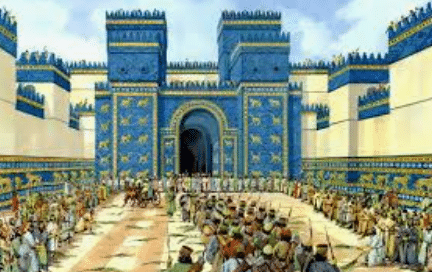
|
theme
… the Akîtu (meaning “the cutting of barley” or alternatively “the house of habitation”
and even “celebration of the house” wasn’t only a devised feast for earthly Babylon
but as Occult Ritual intended to support mystery-Babylon as ‘her heavenly image’
(and hence the ‘celebrating the house’ was “the completion of the Torus-construct”)
as an important aspect that we must keep in mind when decoding this double-event
having a Sumerian origin this New Year festival was celebrated in the Spring in first
month of Nisan right after the Vernal Equinox in March ,
but during Assyrian and Babylonian times it was expanded with a second Akitu feast
being kept in the Autumn in the seventh month of Tishri — and though the author of
the below paper reasons “that this was due to the different calendar which was kept
by the individual city-states so that the Akîtu was held in different times of the year ,
either in the 2nd or 6th or 9th or even 11th month” we must reject this :
first because the rituals in the Nisan Akîtu are clearly different as in the Tishri Akîtu ,
supporting our idea “that the latter provided the conditions fór the Nisan one”
which indeed was ‘more important’ — yet could never exist without the Akîtu in Tishri
the syncretism error concerning ‘Booths’
many scholars hold “that the biblical Spring & Fall feasts were based on both Akîtu”
because in both of them appear themes like “barley”, “(reed-) huts” (in Booths) and
even a “type of demanded penance” ;
yet this is only an exoteric observation ,
because the réal shared theme here is ‘the war of the matrix vs Eden’ so that per
definition a number of similar attributes must show : as concepts that the matrix has
stolen from Eden , as a crime being undone by ‘the Spring and Fall feasts’ of God
important for us : are both Akîtu festivals ‘their inverted year’ ?
or , ‘when does the Eden-year start’ ?
for we saw in a previous page that several aspects of eden-Time were inverted by
the matrix in her (our !) reality , so that we need to know “whether their Akîtu in the
seventh month perhaps was the start of the Eden-year“… ?
which also is important for us concerning our “Passover option ?” (page)
but there is an interesting development for us —
after the ‘garden’ page and this one , the clear difference in rituals in the Akîtu’s
of Spring and Fall (though some aspects overlap) imply that the seventh month one
was devised as “stealing Eden aspects – especially the crystal floor” FOR the feast
as the new-year Akîtu in the first month Nisan ,
and this “providing the ‘conditions’ for Nisan” comes close to our ‘Passover option’ ! <<<
Adam sold ‘the number 10 (our base-10) of the house of Eden’ to the serpent-race ,
reflected in their lore as “having cut off the cedar” which is our sceptre-axis attribute
of birthright now in the dirty hands of their leader Marduk / Gilgamesh [‘Horus’] ;
and after that ,
it cannot be coincidence that their creation epic Ênuma-Êlis is also called ‘the seven
days of creation’ while in the seventh month (-Akîtu) they executed their Great Steal
and in that seventh month “the seventh day” is of crucial importance —
it all looks like they needed the ‘7’ to attack the sacred base-7 of God (sic !) that was
represented by the 7 Torches dancing on the crystal-floor (base-10) they both stole ,
which all is rather sure documented (-in the ‘garden’ page) ;
while in the next (!) Akîtu in the first month their matrix-realm was ready , the stolen
floor & the Torches had been installed , and they could start their matrix “New Year”
now please ,
their Great Steal using a ‘7’ could imply ‘that it was the 7th month of Eden álso’ <<<
[even though there still were ‘the 14-days Full Moon’ and ‘day & night’ differences] ,
since it is difficult to reconcile the above context with “the start of Eden’s new year” ;
so that we need to look at another factor :
perhaps the sacrifice by Christ can be the only possible start of the Eden-year
simply because of the sheer magnitude of it , and equally important , in the sense
that the very ‘fall of Eden’ was made undone right at the start of her new year —
or rephrased ‘as if she never had fallen’ because God never considered his work
as failed or having stopped but instead as one ongoing (creational-) project ,
and exactly this aspect could be a key in our ‘Passover option’ ….
while also Passover directly introduces the sacred week till the day of Unleavened
(as a countering of their “seven days (‘months’?) of creation” ?)
where we posed that it may be “a compressed (-in seven days) restoration of Eden”
by first providing the means tó restoration (Passover) and the restoration itself that
is concluded by mount Sinai — as mount tsiun
considering all the above context we do have a chance this April
the ’12 days’ here (matrix base-12)
another proof that their new-year Akîtu represented ‘a follow-up’ can be the duration
of the festivity in the month Nisan is “a number of rituals over a twelve day period” ,
as a concept very much resembling “the 12 hours of (Egyptian-) Amduat” that uses <<<
stolen Eden-concepts to create and implement their base-12 at the end , also ;
their Ênuma-êlis helpfully clarifying “how Marduk [‘Horus’] has installed the Zodiac”
Jacob (‘you & we’) killed
this stood out — after careful consideration the two killed figurines can only be ‘us’ ,
implying that they were very aware of the major theme of their festival wherefore
they invented this ‘defensive ritual’ ; resembling Rgveda wherein the writer invokes
their gods to punish us when we are finding out about this same (!) theme
| [the ‘(reed-) hut’ , ‘Booths’ and ‘barley’ problem] though the ‘reed hut’ shows at the Akîtu in Tishri and “making huts” also seems to appear in the scroll the latter command most likely is Esau’s corruption and to have Jacob support his Akîtu occult Ritual (!) , for it originally commanded ‘to keep the 10-months’ which directly relates to the crystal-floor theme ; Neh.8 follows the pattern (as Ezra 10) of the people weeping , then sending a proclamation into the land to gather in Jerusalem ‘to declare to keep the 10’ as the original text of “they made huts of palm twigs” [so that the Leviticus 23 paragraphs are also corrupt] ; yet we will need a separate page for this theme — even móre difficult is the subject “barley” of which we are not sure that we can resolve it in this lifetime |

and a rebuild these days |
SUMMARY OF RITUALS
A : the spring Akîtu :
after the successful Great Steal last Tishri now their New Year can start
[note please that the city-states not always had the exact same rituals] :
short descriptions :
#1 V
a festival of 12 days [‘implementing their base-12’]
the common agreement is that it lasted ‘twelve days’
as the day included in “after the 11th day the gods went home” ,
and which as mentioned above resembles the 12 hours of Amduat —
but it also links to “the 12 months of VaruNa” in Rgveda (upcoming page)
#2
anointing the (temple-) gates with oil [‘…. (links to Passover ?) ….’]
[from source [2, p.21] for relevance :]
it immediately reminds of the action at Passover in Egypt
where ‘the door’ can have represented “the opened eden gate” (-below Orion)
but here the temple represents ‘mystery-Babylon’ so this must be “her gate”
and the cedar-oil perhaps “as stolen purified aspects sustaining her gate”
[we will need to find more information about this action of ‘anointing a gate’]
#3
drawing back the curtain before Bêl [‘making contact with mystery-Babylon’]
as making contact with ‘Marduk (‘Horus’) himself’
after which all the priests and singers enter the temple
#4
reciting their Creation Epic [‘confirming their cosmic victory’]
as the Ênuma-Êlis narrating their victory and the fall of Eden ,
this reading probably “as a confirmation of the start of their matrix”
since the Great Steal had already happened in the previous Tishri Akîtu
#5
two ritual places : ‘the Akîtu-house’ and ‘the Esagil temple’ [‘Orion & mystery-Babylon’]
processions happen “from an Akîtu house to the Esagil temple”
where the ‘Akîtu house’ located just outside the city walls must be ‘Orion’
as their hub imprisoning the crystal-floor that now feeds their Torus-construct ;
turning the main Esagil-temple (‘house of the head on high’) into a combination
of ‘representing mystery-Babylon and / or the Torus-construct around her’ ;
the symbology of ‘buildings’ was important for them
[similarly – but different – like how God’s temple represented the eden-Sanctuary]
since the Esagil was “the image on earth of the heavenly (matrix-) situation”
#6
long incantations to ‘Bêl and Bêltiya’ were made [‘that rule Behemoth & Leviathan’]
hence also this ritual makes sense —
mystery-Babylon (c.q the Torus) had been built “inbetween the dual-realm”
as the (still corrupt-) masculine Behemoth and feminine Leviathan double heaven ;
and their prayers to them addressed both deities “as many stars and constellations” —
but per context more likely “as having these constellations WITHIN them”
and see the interesting invocation to Bêltya in Annex
[remember that the serpent in Rgveda also calls the dual-realm ‘my father & mother’]
b)
their built Torus that sat in ‘their new middle-region’ between Behemoth & Leviathan
(taking over the mid-region as attribute of Eden) indeed was “new” ,
because (only) in the previous Tishri Akîtu “Anu was born” as a term for their
new mid-region where Anu is the main god of the Anunnaki “the serpent-race” ;
as another proof that this Nisan their matrix-realm stárted ;
c)
you see how strong this is connected to the main theme of “God’s covenant” <<<
which’ main component also is “the rule over both halves of the heaven” but by Eden ;
#7
then the temple Esagil is ritually purified (1) [‘sanctifying their Torus with base-10’]
curious is the ritual of the slaughtered sheep ,
which’ blood was used to purify the temple with” – but probably ‘to sanctify’ –
after which “its head and carcass were thrown into the river Euphrates” :
now , we cannot prove this was about ‘base 10’ ,
but “disposal of the head (‘root’?)” as an act of ‘not using it anymore’
(yet having ‘sanctified’ the temple with it !) does sound like the base-10 theme ,
especially since the priest performing that ritual was “a sorcerer” as a concept
relating to “by them harnessed Eden-power” — like the ‘mâya’ in Rgveda —
who now ‘was unclean’ and only could return to the temple at the 12th (!) day
[it would be fantastic if it had written “10 sheep” but we can’t find that anywhere] ;
and compare this possible theme to next :
#8
and ‘a golden canopy’ (tent) was brought in (2) [‘start of base-12 Torus’]
as extended over a statue of Bêl — as Marduk / Horus now ;
though further information is scarce the idea resembles expressions in Rgveda
wherein they praise ‘the golden dwelling’ that appears to be about their ‘renewed’
and now very powerful Torus-construct ;
#9
a ‘ritual-pit’ (-and the crystal-floor inside it) [‘securing the stolen floor’]
the “pit or cistern” is a red flag for us ,
as “the clay or gloomy cave” in which the matrix imprisoned the crystal-floor <<<
and as the important theme in the Scroll we only discovered two months ago ;
[here ,
the king goes outside to “the courtyard of the temple where this pit is located”
[oh – so “the (bottom of-) the altar in the Tabernacle’s courtyard IS the floor” ? , [sic]
where several survived lines (but corrupted by Esau in a graveyard chapter)
about “pouring blood into the altar reaching the foundation of it”
must have been “a foundation of 10 large stones” — like the crystal floor —
and compare the 10 large stones altar at the Jordan crossing] ,
so ,
the king goes outside to that ritual pit :
problem is that ‘Orion’ must be “the Akîtu house” outside the city (‘far away’)
while this courtyard is ‘close to the temple’ — but perhaps they mean the same ;
b)
in the previous Tishri Akîtu “the floor (Lugaldukuga) was placed IN the pit” [sic]
and saying that because this paper does not refer to that aspect ;
but does mention “the pit filled with honey and oil”
which is exactly what Rgveda also describes : the now ‘purified’ light-particles
emitted by the floor is their ‘Soma’ as “tiny drops of honey” as light-particles <<<
now mixed with their own ‘ghee’ – and compare ‘oil’ here ;
in this Nisan Akîtu ,
the “king sets fire to the (contents of the-) pit” that sounds like an ‘igniting’
as a starting of their new matrix (-year) by activating the stolen crystal floor ;
where “the slaughtered bull” mist probably represents ‘the floor’ (see Rgveda)
as ‘a powerful construct’ that is sacrificed ‘for the next year’
#10
the shrine of ‘destinations’ (ME’s) [‘creating everything by base-10 and -7’]
in the ‘garden’ page we linked the ME’s to ‘base-10’
as the 10 of Eden that Adam sold to Horus — and hence in their Ênuma-Êlis
epic ‘Marduk took the ME’s from Kingu’ who perhaps represented ‘Adam’ —
and note how this ritual follows áfter the ritual-pit one :
wherefore these ME’s can have been a combination of base-10 ánd -7
since now they commanded both the floor ánd 7 Torches upón him ;
so that perhaps the difference with ‘the previous slaughtered sheep’ is ,
| that ‘they now could create anything they want’ including their own base-12 and in any combination , per Rgveda ‘a 100-fold’ ‘1000-fold’ and even ‘3 x 7’ as an endless variety of concepts also against Eden ; now Nabu (Thoth) enters the scene , but it’s difficult to see what happens : his statue is brought to ‘the house of mountains’ that cóuld be the same as the Egyptian “island of the horizon” showing two hills – as “Babylon’s gate just beneath her” ; hence “Thoth as sorcerer working the seven flames” (from Seti’s tomb , to right) could depict this (-place) |

|
#11
the ‘humiliation of the king’ [‘securing the Akîtu ritual itself’]
[though this happened earlier – but because of next 12]
as the most well-known ritual at this Akîtu , though in truth difficult to decode :
to us it seems a personal ritual of “the demon-overlords making sure that their
earthly kings would continue this whole Akitu-occult-Ritual each year”
and ofcourse for sake of the continuation of mystery-Babylon ;
b)
the long ‘confession’ (see paper) in which the king seems to justify himself
looks very much like the so-called “negative confession” in the Book of the Dead
which ofcourse were wrongly translated ,
as a series of proclamations ‘(Eden-) will nót destroy us’ — as the same here ?
c)
the type ‘humiliation’ here is another as the mock-penance in the Fall Akîtu !
#12
the two decapitated figurines [‘securing that Jacob is silenced’]
[this also happened a bit earlier but to juxtapose with #11]
tricky — but because of the figurines which they themselves made
from two different type wood and dressed up with reddish-brown garments ,
per context these figures must be “us” : the ruddish refers to an Eden-origin
(as it does in the Spells and compare ‘Adam’ ‘ruddish’) where this body that
we now have indeed is one that théy devised — c.q ‘Adam devised’ ;
where [2] adds “that these figures were fed by the left-overs of the meal that
had been offered to their gods” (that is true – we get the scraps from them) ;
but especially because of ‘the decapitation of both figurines’ almost like
some weird Voodoo ritual so that we would never rule (‘head’) again —
#13
the ritual of sacred marriage [‘the Torus of Western-nature anchored in space’]
also this one is a bit difficult —
we had another type ritual marriage ‘of the king’ in the seventh month Akitu ,
but here must happen “the marriage between the deities Ishtar and Enlil” :
where Ishtar must represent the “rule of the Torus-construct itself” who now
| wears “her crown with battlements” (to right) that could represent “mystery-Babylon” but also herself (as Torus) anchored in Space through her ‘battlements’ as their Zodiac (and please also see other ‘garden’ page) ; where her counterpart ‘Enlil’ is difficult : because their Torus dwells in the Behemoth realm the latter can be ‘Enlil’ — not as ‘Bêl’ but as the consciousness óf Behemoth : yet as “corrupt one” according to the Scroll since only ‘restored Eden’ will purify both halves of heaven again |

|
[added :
this ‘marriage’ can show how the Torus took ‘the evil nature of the West’ just as
the Spells often mention that their matrix-realm is as that of the West ÁMENT
(that for its existence is vampiring off ‘the East’ ÁABT — ultimately as Heaven) ;
reconstructing this , though not in the Scroll ,
when Satan was cast out of Heaven he occupied ‘the far-West dimension’ ,
then (probably) he took over the northern half of heaven Behemoth between both
therewith “polluting its consciousness” – that does show in the Scroll –
and (probably) through this “the serpent-race” came into being and these races
were placed upon the shore of Heaven as ‘the south-land’ right in front of her ,
so that “the West had contact with her” in order “to keep vampiring off of her” ;
Rgveda has a weird chapter ,
describing “the horse-head amassing his armies to attack the East” which most
likely describes the above original invasion of the south-land ,
because , after Eden fell and the serpent-race ruled again , they had moved from
their ‘mother-land’ (eastern half of the south-land) to the North to start their Torus
construct north of the Eden-realm ;
in this context it is almost logical that “Ishtar married Enlil” as ‘nature of the West’
(and probably the same as the deity ‘Indra’ in Rgveda) but we need to look again
what was “the marriage of the king and the goddess” in the seventh month about
[needless to say that their whole construct will perish ,
as eventually (Satan and-) the evil Western dimension will cease as it is]
B : the fall Akîtu :
[it seemed best to not post the rituals in the Tishri Akîtu in this place
for it would confuse – after all the above that also is much
the summary of this first festival shows in top of the “garden” page]
for you , our Majesty
because why would we be lesser in understanding as them Esau sons
yet , we are waiting for the moment that you want to accept us
the New Year ceremonies in ancient Babylon
[J.A. Black]
[our comments in blue and in jumped lines]
(40)
“The New Year ceremonies at Babylon, and in particular that called the Akîtu were
par excellence Marduk’s festival; but related ceremonies were celebrated in other
cities and had been celebrated for a very long time. Most of the material here
represented derives from the couple of hundred years immediately before the fall of
Babylon in 539 BC. Yet a festival called the akitu was being celebrated at Ur in the
south of Babylonia two thousand years before that, and that is where we must begin.
Administrative documents recording deliveries of animals for sacrifice and special
offerings reveal certain details about the festival as it was celebrated at Ur and other
cities in early times. The word akitu in Sumerian, borrowed from Akkadian refers both
to the festival and to the building where it was held [……..] . This building was always
situated in the fields outside the town. At Ur it was at a village near by where there
was a temple of Nanna, the patronal deity of Ur. [….] [and] like most akitu buildings,
it was built near a quay on the canal, and references show that Nanna’s statue was
transported to the building at least part of the way by barge. In Nippur an akitu was
held for Enlil and his consort Ninlil. In all cities it appears to have included a sacred
ceremony of marriage.”
[here ,
the Akitu-building as ‘Orion’ , the canal as ‘the axis from him to the Torus’
and the city in question ‘the Torus itself’ (or alternatively ‘mystery-Babylon’) ;
the ‘sacred marriages’ were held in both Akitus , see ‘garden’ page ;
(41)
“The Mesopotamian year began at about the time of the spring equinox, directly after
the barley harvest, except possibly in early times in Assyria and also at Ebla (in Syria),
where it may have been counted from the autumn. Sometimes a second ‘catch’ crop
could be sown and harvested before the rains began in the middle of September and
the main sowing took place. Now at Ur, an akitu was celebrated twice a year:
in the sixth month, called the Sowing akitu, as this immediately preceded the principal
sowing of barley; and in the first month of the year, after the barley harvest. This latter
was known as the Harvest akitu and followed Harvest Month, the twelfth month.
At other cities with other calendars, an akitu was celebrated in the 4th, 5th, 7th, 8th or
even in the 10th month.”
[here ,
the supplied information by scholars is not always uniform ; where a theme in the
‘garden’ page was “about the wars of Horus in the 2nd, 7th and 9th month” which
can have been the reason for ‘the different timings here’ (and that on top of the
different calendars he mentioned before) which were not always understood (?) ;
(41)
“But what need is there to insist that either of these ancient festivals is the ‘original’ ?
The point here is that an akitu at Babylon was celebrated only once a year for Marduk
and that the time of it—during the first twelve days of the first month Nisan, round
about the spring equinox—corresponds more or less exactly with the much more
ancient so-called Harvest akitu of Ur.”
[here ,
well for us it is a great deal – for they were subsequent feasts carrying certain
themes as one feast leading up to the other , and not just “the same feast that people
randomly placed within a running year according to their own customs” ;
(42)
“The last known occasion on which the akitu of Bel-Marduk was celebrated was in 538
when Cambyses, son of Cyrus the Persian, ‘took Bel by the hand’ on his father’s behalf.
The temples of Babylon were destroyed after a revolt in 482, when Xerxes removed the
statue of Bel.”
[here ,
anóther reason ‘why they were never started up again’ was in our opinion ‘the Scroll’
since after it was captured the Great Coverup began ;
that the old-Persian ‘Nowruz and Mithragan’ remained – as offshoots of the Akitu –
perhaps was not a danger , diffused as they had become ;
(42)
“The akitu and other New Year ceremonies were celebrated from the 1st to the 12th of
Nisan. As observed above, the actual date of 1st Nisan varied from year to year but was
generally fixed to be as near to the vernal equinox (about 21st March) as possible.
During the period 626–536 BC it was sometimes as early as 16th March and sometimes
as late as 31st April. [we are looking at ‘April’ too] . The first few days consisted of ritual
preparations, culminating on the 5th Nisan..The great climax was from the 8th to the 11th.
Of the first day’s ceremonies we know nothing.
On the second day the sesgallu or high priest rises at about 4 a.m., bathes and enters the
sanctuary of Bel [‘Marduk / Horus’ here] , where he draws back the linen curtain in front
of the god’s statue. He prays a secret prayer, ending with the words :
Have pity on your city of Babylon,
Turn your face upon your temple Esagil,
Maintain the freedoms of the privileged citizens of Babylon.
Then he opens up the temple and admits the rank-and-file priests, singers and musicians,
who go about their regular duties. A further prayer followed, but the text is badly damaged.”
[here ,
the “opening the curtain” is “invoking the other (matrix-) reality” where Horus resides
since the events on earth as ritual reflected the situation in the matrix-reality ;
in this context the ‘freedoms’ already suggest “against Eden” ;
(42)
“On the third day, a similar sequence of events takes place, and about half-way through the
morning the sesgallu sends for a smith and a carpenter, who are issued with materials for
to make two small images which for the next three days will stand in the temple of Madanu
the Divine Judge, and be offered food from his table.
These are small, wooden, human figures, 7 inches high, one of cedar and one of tamarisk
wood, shaped in an attitude of reverence to Nabu [and] clothed in red-brown garments.”
[here ,
the figurines perhaps as ‘our male & female Original’ but the context is ‘the cosmos’ —
because the figurines will be ‘killed’ (decapitated) later on , perhaps they did represent
our Originals in the sense ‘that they previously ruled the cosmos (with Eden’s base-10) ?
[alternatively ,
both could represent a personified eden binary sun & moon as captured ones needed
to make their ‘base-12’ ,where Nabu (Thoth) in the Spells [also] is “an axis into Eden”
and that ‘thanks to him the binary was captured’ — but perhaps that is a stretch ?]
b)
the judge ‘Madanu’ (or Mandanu) is unclear but relates to the Anunnaki serpent-race ;
next :
the above assumption may be true if “Bel & Belitya” are “Behemoth & Leviathan”
[and see the interesting addition about ‘Sarpanitum’ in Annex] :
(42-43)
“On the fourth day the sesgallu first addresses Bel with a ‘raising of the hand’ or prayer of
intercession. Then, entering the adjacent shrine of Bel’s wife he prays to her, addressing
her by her title Beltiya (My Lady) and by her name Sarpanitum. He then goes out into the
courtyard and, facing north, blesses the temple Esagil three times: Field-star, Esagil,
image of heaven and earth. Esagil was regarded as terrestrial replica of the constellation
called the Field-star. Only then are the other clergy admitted.
On this same day, the king sets out for Borsippa, a town ten miles south-west of Babylon,
to fetch the statue of its patronal deity, Nabu, known as the first-born son of Marduk, from
his home temple, Ezida. In the cool of the evening, after the offering meal, the sesgallu then
‘offers’ to Bel, that is, presumably, recites, the whole Epic of Creation,
during which the crown of An and the seat of Enlil, cult objects, remain veiled.”
[here ,
Sarpanit (Zarpanitu) ‘together with her consort rules the sea where the name-attribute
Ninabdubur as “lady of the sea foundation” would suit ‘her’ as ‘Leviathan’ in the south —
as ‘foundation’ ;
the ‘field-star’ seems to be (ikû) , the constellation Pegasus ;
where a tablet has “In the month Šabāṭu (XI), Venus(’s celestial counterpart is) the
Ikû-of-Babylon-star because she gave the crown of kingship to Marduk.” ,
where however “stars (and constellations and even planets) represented a concept”
so that ‘the field of Babylon’ looks very much like the Field of Reeds (-in the Spells)
as ‘the paradise of the city mystery-Babylon’ ;
[this theme is most interesting but too long here – please see Annex below]
(43)
“On the 5th six ceremonies take place. After the usual preparation the sesgallu enters the [5th is long :]
shrines and prays at length, in a mixture of Sumerian and Akkadian, to Bel and Beltiya in
turn. Both prayers are particularly notable in that they address the deities as a series
of constellations or planets, a feature to which I shall refer later. At about 8 in the morning
the second ceremony on the day begins. After the gods have had their breakfast served to
them, the sesgallu summons a masmassu or sorcerer to clean and asperge the temple of
Bel. The sesgallu retires at this point, for if he witnesses the cleaning of the temple he will
become unclean himself. The sorcerer cleans the temple, sprinkles it with water then bangs
a sacred drum to drive out the evil spirits and goes round with a censer and lights.
But he may not himself enter the sanctuary. This is quite clearly pointed out.”
[here ,
difficult : perhaps their Torus (as temple) ‘was already constructed’
(but with stolen Eden aspects) and the sorcerer is now “weaponizing those stolen
aspects against Eden” — Rgveda has a similar concept ‘mâya’ “sorcery” but as a type
harnessed power stolen from eden ; as the reason “he may not enter the building” ;
next :
“When this is accomplished, he goes to a second shrine within the Esagil area. This is Ezida
the shrine of Nabu. It bears the same name as the home temple of Nabu in Borsippa to which
the king has gone to fetch the god. Nebuchadrezzar II mentions it in an inscription:
Ezida in Esagil, the shrine of Nabfi, into whose courtyard at the New Year,
at the beginning of the year, at the akitu festival Nabu the victorious son
comes in procession from Borsippa before taking up residence within,
This the sorcerer cleanses in the same way. It is clearly stated that he can’t go into the
sanctuary of this shrine and clean that as well. The sanctuary is vacant as the statue of
Nabu has not yet arrived.”
[here ,
this is unclear – was this another name for ‘the Akitu-house outside the city’
or another shrine altogether ? for now we keep this shrine of Thoth as ‘Orion’ ;
next :
again unclear : which temple is ‘sanctified with the sheep’ , the main one or Orion ?
the author makes the case (below) that this was Thoth’s house (‘Orion’) while we
interpreted the sacrifice of the sheep as ‘sanctifying it with base-10’ —
while in the Spells (the BD one) is said ‘that Orion carries the 12 stars (Zodiac)’
by “(matrix-) existence – to make (-by eden) (ÁR)” as main concept
so that a link of base-10 with ‘Orion’ here is not impossible
(and note how still ‘the sorcerer’ is involved) ;
as
“The sorcerer calls in a slaughterer who decapitates a sheep, with the corpse of which he will
purify the temple. (The word used here is ukappar, literally ‘wipe clean’, but often used in the
sense of ‘make cultically pure’.) He recites spells to cleanse the temple, and then taking the
corpse he throws it away into the river Euphrates which flows past the temple. The slaughterer
does the same with the sheep’s head.
Since the sorcerer is clearly described as purifying the whole sanctuary with the sheep’s carcass
and since he was not allowed into Bel’s sanctuary, it is evident and crucial that the business with
the dead sheep concerned the shrine of Nabu, and not that of the deity usually thought of as
central to the rites, Bel-Marduk. The sorcerer and slaughterer are now unclean and must leave
Babylon for the country. They may not return until the 12th, when Nabu has left Babylon.”
“The next ceremony, the fourth, also concerns the preparation of Nabu’s shrine.
The sesgallu returns and calls in the workmen to fetch from the treasury of Marduk a splendid
canopy called the Golden Heaven, which is then used to cover Ezida, the shrine of Nabu
‘from the tallu to the temple foundations’. Now the tallu appears to be a sort of wooden frame
on which a canopy might be hung. An Assyrian letter referring to preparations for an Akitu says :
I have renewed the tullu (an Assyrian dialectal form of the same word)
and the dragon decoration in which Nabu’s statue stands,
and I have restored the seat inside the canopy-hangings.
From other sources we learn that the tallu was made of cedar and fir beams round which metal
bands were fastened and to which fillets were attached. Sydney Smith wanted to interpret this
as a sort of sacred Maypole, an attempt to revive nature by sympathetic magic which was totally
absent (the thought) from the Babylonian ritual. Smith thought of the Assyrians as a separate
people of West Semitic origin. His views, however, no longer stand, as a number of references
to the tallu exist in Babylonian sources which make quite clear what its function was: to support
the canopy.
As they erect the canopy, the sesgallu and workmen chant an incantation. The workmen depart.
It’s now time to feed Marduk again. The sesgallu offers the food and says a prayer of intercession.
Then the workmen are called in once again to take the tables of food away for Nabu, who is just
about to arrive by canal at a wharf south of the city walls. The food is set before him as his statue
is disembarked from his sacred barge the lda-hedu. The king who accompanies him is offered
water to wash his hands and is escorted to Esagil by the workmen who remain outside.
(Nabu’s statue is probably taken off elsewhere for the moment.)”
[here ,
the golden canopy (probably the installed base-12) follows well after the ‘sheep’ (base-10)
“The king enters the temple and the fifth ceremony of the day begins.
The sesgallu who is in the sanctuary comes out and deprives the king of his staff of office, ring,
mace and crown. These insignia he takes into the sanctuary and places on a seat. Coming out
again, he strikes the king across the face. He now leads him into the sanctuary and, pulling him
by the ears, forces him to kneel before the god. The king utters the formula :
I have not sinned, Lord of the lands, I have not been negligent of your godhead.
I have not destroyed Babylon, I have not ordered her to be dispersed.
I have not made Esagil quake, I have not forgotten its rites.
I have not struck the privileged citizens in the faces, I have not humiliated them.
I have paid attention to Babylon, I have not destroyed her walls…
Then he leaves the sanctuary. The sesgallu replies to this with an assurance of Bel’s favour and
indulgence towards the king: ‘He will destroy your enemies, defeat your adversaries’, and then
the king regains the customary composure of his expression and is reinvested with his insignia,
fetched by the sesgallu from within the sanctuary. Once more he strikes the king across the face,
for an omen: if the king’s tears flow, Bel is favourably disposed; if not, he is angry.”
[here ,
[much is written by scholars about this event – but this is a tricky one]
this ‘humiliation-ritual’ is different from the mock-penance in the 7th month Akitu ,
and seems to be “an ensuring that the kings will keep performing the Akitu feasts”
since the scene centers so much ‘around the king himself’ ;
next :
the ‘ritual pit’ is “the pit of clay (at Orion) in which they placed the crystal floor”
but already in the 7th month the floor was placed in there
so that the translation form here must be ‘a ritual of maintaining that situation’
as
“The final ritual of the day, also involving the king, takes place just before sunset.
A pit or cistern is opened up in the temple courtyard, a bundle of reeds is laid in it,
and honey, ghee and best quality oil, typical sacrificial items, are poured over them.
A white bull is — slaughtered ? — the text is broken at this point — before the pit,
and the king sets fire to the material in it.
Together he and the sesgallu utter a prayer addressed to the planet Mercury whose heliacal
rising occurs at the New Year in the month of Nisan, and which is called the ‘star of Marduk’.
(45)
“On the following day, the 6th of Nisan, the other gods’ statues arrive in Babylon [next day :]
from their home sanctuaries in the surrounding towns. Nabu’s is brought to the temple
E-hursang-tila, and on its arrival a slaughterer strikes off the heads from the two little human
statues dressed in red garments, whereupon a fire is lit and they are burnt before the god.
(This is not the same slaughterer as assisted in the cleaning of the temple as he has to remain
outside the city at this stage.)”
[here ,
you see how problematic these two statues are —
their ‘red-brown garment’ cóuld refer to (-adm) ‘ruddish’ as the attribute of our Originals
[while if they were ‘the binary’ the creational-time-table is very off by now] ;
it almost sounds like a kind of Voodoo , this ; and because previously ‘the king himself’
was involved it is not impossible that now our Originals – or even ‘their souls’ as ‘Jacob’
are now ritually killed ;
that “they made the statutes” can be “just as they designed these bodies we have now”
where the decapitation refers to ‘rule’ – as “never again acquiring rule” ;
considered all context the statues must be we ;
(45)
“On the 8th (or according to Frankfort, on the 7th) Marduk was ready to come forth from his
temple. The next few details are taken from a ritual celebration at Uruk for An and Ishtar in the
seventh month, but they are probably very similar to what happened at Babylon.
Someone, probably the priest, offered the god holy water and then sprinkled it over the king and
the people. The priest, or according to one text from Uruk, the king, went into the sanctuary and
poured a libation. The king, ‘taking Bel by the hand’, brought him out into the courtyard where he
was enthroned among the hanging curtains of a canopy. This ‘taking by the hand’ anticipates the
principal ‘taking by the hand’ which later inaugurates the grand procession.
The phrase is often used in chronicles as a shorthand to refer to the whole akitu festival.
Thus we read: 13th year, Sargon took Bel by the hand. This ‘taking by the hand’ was not just a
ceremony in itself, as was suggested by some commentators who saw it as a ritual of a royal
investiture [but] it constitutes in the present context no more than an invitation to depart.”
[here ,
the ‘taking by the hand’ sounds like simple slang for “performing an occult ritual” ;
next :
this theme “destinies” (the ME’s) is very tricky —
in the ‘garden’ page we equated it with their captured ‘base-10’ (and probably coupled
with the captured base-7) in the sense ‘that they now can make anything they want’
a 100-fold, 1000-fold and even 3 x 7 fold (see Rgveda) , and perhaps any combination
| since they command the floor but also the seven Torches standing upon it ! ; b) but the here mentioned “shrine of destinies” is unclear — because it is the shrine of Nabu it may be ‘the sorcery place of Thoth’ where he “creates with 7 (stolen) flames’ as in the Seti tomb mural , to right ; and perhaps – for it was ‘close to the temple’ this place was at the island of the horizon as the gate just below mystery-Babylon ; c) the remark of Nebuchadrezzar (below) does not imply ‘destinies upon this earth’ but for his afterlife (in the matrix) as ‘distant days’ ; |
|
(45-46)
“Marduk was next led to the Shrine of the Destinies, which, as we learn from an inscription
of Nebuchadrezzar II, was where ‘at the New Year, at the beginning of the year, on the 8th
and 11th days, “Lugal-dimmer-an-ki-a” or “Lord of the gods” rests’.
[this figure] , the Divine King of Heaven and Earth is one of Marduk’s fifty names as the gods
say in the Epic of Creation […………] ”
[looking at that list it shows “many different areas of creation” so that indeed it can show
their now almost unlimited possibilities to create (including the base-12 Zodiac !) through
the captured base-10 and base-7]
“Now this Shrine of the Destinies was in Ezida, the shrine of Nabfi in the Esagil area, that was
earlier purified and ritually prepared by the sorcerer [with base-10 !] . And in this Shrine of the
Destinies Marduk was now acclaimed as almighty in the presence of the other gods, whose
statues were gathered there, and invested with supreme authority. This was the occasion of
the first ceremony of ‘decreeing the destinies’.
The second ceremony took place on the 11th , and on this [….] occasion, the destinies of the
king were determined. ‘They determine in there the destinies of distant days, the destinies of
my life’, writes Nebuchadrezzar.
What exactly this involved we cannot know. Maybe oracles and omens for the coming year
were published: Babylonian omens were characteristically interpreted as concerning the king
directly. Maybe it was a general affirmation of the king’s authority. At any rate it serves here to
underline the importance of the part played personally by the king in this stage of the festival.”
[here ,
this sounds like the in origin Egyptian ‘circumcision occult ritual’ devised to keep open
the northern Eden gate — where that ‘sacrifice’ (to the poor egyptian Esaus) on earth
was countered with “great promises for their KA (spirit double) in the matrix-afterlife” ;
next :
“Then, according to a fragment of a text describing the ritual, the doors of the shrine were flung
open, the priests crying: Go forth, Bel! O king, go forth! Go forth, Our Lady, the king awaits you !
where Our Lady is another title of Bel’s consort. The king once again ‘took Bel by the hand’,
and thereby initiated the most popular phase of the festival :
the grand procession of all the gods and goddesses along Procession Street, its walls faced
with splendid turquoise glazed bricks decorated with mythical monsters of terrifying aspect and
indeterminate pedigree (which is seen reconstructed in the Pergamon Museum in East Berlin).
Marduk went forth and the populace knelt before him. The slightest accidental irregularity in the
proceedings even a sudden movement of the horse pulling Marduk’s chariot, would be eagerly
interpreted as an omen of the divine will. And accompanied by musicians and singers, the vast
cortege wound its way past the Hanging Gardens, through the Ishtar Gate and then made for a
landing stage on the Euphrates just outside the city walls to the north.
This procession could easily be turned by kings into an opportunity for the display of their armed
forces, tribute and prisoners. From here it travelled some way by boat, and then, disembarking,
followed the broad avenue planted with cedars of Lebanon by Nebuchadrezzar unto the akitu
building.”
[here ,
is the procession now ‘going the other way’ , to the Akitu (‘to Orion’) “to secure that place”
from which their Tirus receives ‘(stolen-) ânkh-life’ ?
next :
“Sennacherib relates how he rebuilt the akitu building at Ashur, which stood about 200 yards
outside the city walls, and planted a delightful park around it. The bronze doors of the house he
had ornamented with scenes depicting the defeat of Kingu from the Epic of Creation, but with
Ashur, his own national god as victor in place of Marduk. Excavations confirmed his description”
[ah ,
Kingu , the servant of Tiamat (‘Eden’ as mid-region) carried the ME , the ‘destinies’ that
were taken from him by Marduk / Horus (‘taken from Enmesharra’ is the same theme) ,
so that our impression “that the Akitu-house was ‘Orion’ now having base-10 ,
and “that Thoth shrine near the main temple creáting things by base-10” can be valid ;
[at this point the ‘sacred marriage’ theme appears ,
though the author is not sure which version was true — but considering the ‘garden’ page
the main marriage seems probable (not the one of the king in the 7th month)
as that between Ishtar and Enlil : Ishtar (‘rule of their Torus’ aka ISIS) with her crown of
battlements – as their Zodiac – marrying the consciousness of the Behemoth-realm]
(48)
“On the 11th, which was the final day of the festivities, the procession returned to Babylon for
a final assembly of all the gods in the Shrine of the Destinies in Nabu’s [sorcery-] temple.
This time the ‘destinies of the land’ were fixed, and yet another banquet ensued.
Next day [the 12th ‘when all the gods went home’] Nabu’s statue was returned to its home in
Borsippa and the other gods were dispersed to their own home shrines. The sorcerer and the
slaughterer were free to enter the city once again.”
II
[page 48-end : listing all the interpretations of scholars about the meaning of this event
that anyway are all wrong since they never put ‘Eden’ (vs the matrix) into the equation ,
wherefore it has no Sense to post those here — please see the closing text in the PDF ;
though we have to admit that Black’s paper up until this point was a pleasant reading]
ANNEX
Babylon ‘as the image of mystery-Babylon’ , anchored into the stars
[from [5] p.107 :]
“The ‘celestial writing’ represented by the stars could furthermore serve as a model
and archetype for the topographical setting of temples and royal cities (CAD S 3:146a)
and one of Esarhaddon’s Babylonian inscriptions describes the newly built Esagil temple
in Babylon as “a palace of the gods , mirror (matlat) of the Apsu <<<
(the subterranean sweet water horizon) , equivalent (tamsilu) of the Esharra temple ,
counterpart of the dwelling of EA and equivalent of the Ikû-constellation.”
[here ,
the type writing & used terms work a bit confusing ,
the temple itself called “house of the universe (or ‘of power’) represented the city
of mystery-Babylon inside the Torus , where the Torus-realm here is ‘the Apsu’
(same as the Egyptian TUAT) ,
yet the symbolism of the temple – especially when ‘stars’ were involved – was a
bit wider expanded as ‘representing their Torus-construct’ also ;
b)
because of the Îku-constellation here (Pegasus ‘the field’) that represented their
paradise as the ‘Field of Reeds’ (-in the Spells) surrounding mystery-Babylon ;
cont.:]
“Here , partly in accordance with ideas articulated in Enuma-elis [‘matrix creation story’]
and the Babylonian Akîtu liturgy , several cosmological entities are claimed to have been
the model of Babylon’s greatest temple , among them the constellation of the Field star
(Ikû) corresponding to Pegasus . When Esarhaddon’s father Sennacherib between 690
and 681 restructured the Ashur temple in Ashur in order to create a cultic infrastructure
that fit his religious reform plans , the Esagil served in several respects as a model for
the new building . Probably inspired by its astral features , Sennacherib had erected a
number of gates around a new eastern courtyard of the temple of Ashur and gave them
names that refer to stars and constellations such as ‘gate-of-the-wagon-star’ and
‘gate-of-the-path-of-(stars of)-Enlil’ .
Astral references can also be found in Sennacherib’s accounts of his massive efforts to
rebuild and enlarge the city of Nineveh which became the greatest metropolis of its
time during his reign . Sennacherib describes the city with the following words :
Nineveh , the exalted cult center , the beloved city of Ishtar , wherein are all the rites
of gods and goddesses , the everlasting foundation , the eternal base , whose plan
had been designed of old and whose structure had been made beautiful along with
[or ‘according to’] ‘the celestial writing’ , a fine-looking place , a dwelling of mystery ,
where all kinds of artistic craftmanship and all the rituals , the secret of Lalgar
[a synonym of the Apsu , the subterranean abode of EA] , had been brough together
[or ‘studied’] .
[………] In any case , Assyrian capitals were apparently in some way conceptualized as
‘heavenly cities’ . In another display of their belief in astral power, the Assyrian kings
Sargon II and Esarhaddon , in order to record their names and title, occasionally used
a newly devised pictographic script that was , in ways not yet fully understood ,
connected to ‘the heavenly writing’ of stars and constellations . Esarhaddon describes
the characters of this writing-system as “lumâse (that is , ‘astral constellations’) ,
the counterparts of (the writing of-) my name”.
[here ,
so that several constellations represented an aspect of mystery-Babylon herself ,
while other constellations related to ‘the Torus-construct around her’ as the Zodiac
and Ursa Major strengthening that construct — and also see next :
Babylon ‘as the image of mystery-Babylon’ , anchored into the stars [II]
[plus “the prayer unto Leviathan”]
[from [6] , p.185]
“The Babylonian and Assyrian temple cults became more focused on the luminaries of
the night sky during the course of the first millenium BC. Offerings and prayers to stars
and planets in the context of cultic worship are attested from the early first millenium
onwards . In a short section on astral omina in Mul.Apin [‘star lists’] it is stated that once
the constellations Eridu (parts of Puppis and Vela) and SU.PA (Bootes) will have become
visible offerings must be made to them ; the same is said about the five planets in a few
lines later .
[here ,
they had divided the sky into ‘an equatorial zone’ and the southern and northern
hemisphere listing their stars [solariapublications.com/2011/10/25/mul-apin/] ,
but remember they viewed the latter both as ‘Leviathan and Behemoth’ ;
while in many cases “the planets” equated certain stars so that their phrase ‘Niburu’
did not mean ‘Jupiter’ (for that makes no sense) but likely a constellation which for
them represented ‘the opened eden gate’ in the Niburu “place of the crossing” ;
cont.:]
“Stars , planets and constellations as divine beings were an integral part of the pantheon
of the Neo-Assyrian empire. In several of their vassal treaties Esathaddon , Assurbanipal
and Sin-sar-iskun have invoked the five planets and Sirius as witnesses to the concluding
of treaties themselves and in the curse section among the deities who will ruin the life of
anyone who destroys the document.”
[here ,
this sounds like “related to the after-life” just like Nebuchadrezzar with the ME’s ,
and also very much like “the wrath of Mithra” in Persian lore – where he was linked to
the ‘treaty’ or ‘covenant’ theme related to ‘the fixed-order of the (matrix-) cosmos’ but
through the stolen base-10 ofcourse (as attribute óf Mithra) ;
cont.:]
“Further , the names of the gates of the eastern annexe of the Ashur temple which was
constructed by Sennacherib include the Gate of the Firmament , the Gate of the path of
the Enlil stars [Behemoth] and the Gate of the Wagon constellation were chosen to evoke
an association between the temple and the geography of heaven.
That choice not only reflected astronomical insights of the period but also the theological
view that the north, represented in the sky by the constellation Cancer, was the realm of
kingship where the throne of Ashur could be found.”
[here ,
having expected ’12 gates’ per the Zodiac , curiously that is not the case —
instead the courtyard had four pairs of gates so that perhaps as the (matrix-) doubled
cardinal-points like ‘the star of Ishtar’ aka the 8-pointed Chaldean star ;
cont.:]
“However , not much material from Assyria has been preserved which might indicate that
stars and planets were also recipients of regular worship in the city’s temple cults. In the
Neo-Assyrian ritual text K 252 the king is described as making offerings ‘to the stars’ that
is followed by a list of major deities whose astral forms are probably meant ,
and two individual stars , Sirius and the Yoke-star (Bootis) .
The Assyrian ‘Offering Bread Hemerology’ names for each day of the year the appropriate
deity to whom one should bring a food offering , including the planet Venus and also the
constellations Orion , Sulpae , Pisces and Pleiades ; likewise , the royal hemerology ‘Fruit,
Lord of the Month’ instructs the king to go sacrifice to , among others , Orion, the Wagon,
the Pole star, the Pig star, Venus , the Plough star and Pisces .
An important divine collective worshipped in the regular temple cults at Nineveh and Kalhu
were ‘the Sebetti’ [sic] , the seven warriors of Nergal who were related to the constellation
Pleiades in the same way that Sin , Samas and Ishtar were related to the moon , the sun
and the planet Venus . On Nea-Assyrian cylinder seals those three heavenly bodies are
frequently depicted together with the Pleiades whose rising coincided with the harvest.”
[here ,
these “seven” were “the seven stolen flames from the Sanctuary” that Marduk took off
their defeated ‘father’ Enmesharra (having the ME’s) and as the ‘sons’ that worked for
the matrix ; though several months ago when finding this theme we did not know yet
how Sumer-Babylon indeed identified these concept with ‘visible constellations’
[though we should have – for Egypt did the same] ;
and important , this happened in the Tishri Akîtu ;
in the above , ‘venus & this moon’ are but down-gradements , see earlier ;
cont.:]
“Apart from the evidence from Seleucid Uruk no sources exist that point to the regular [Nisan Akîtu :]
offerings provided to stars and planets in temple cults of first millenium Babylonian cities.
However, three ritual texts give evidence of the invocation of stars on special occasions.
Firstly, in one of the late Babylonian scripts describing the Akîtu festival in Babylon in
month 1 (Nissannu) the high-priest is instructed to address the deities Bêl and Bêltiya
each morning with a long prayer during the ‘awakening of the temple’ (dîk bîti) ceremony .
On day four the prayer to Bêltiya describes her as a star or planet which moves brightly
across the sky :
Zarpanîtu , most brilliant of the stars , who resides in Eu (d) ul ,
most attractive (?) of the female deities , whose garment is light ,
who crosses the Heaven , who watches over Earth ,
Zarpanîtu , whose (heavenly) station is sublime ,
bright is Bêltiya , exalted and sublime !
[here ,
because Zarpanitu (Sarpanitu) is the female ‘Leviathan’ – and see text ! ,
it must have written in the context of “of most brilliant stars (-within her)” ;
while the “crossing over” could mean “how Behemoth and Leviathan had
mixed again after [the barrier-] Eden had fallen” so said in the book Enoch ;
cont.:]
“Likewise , the prayer to Bêl which is partly broken , describes him as ‘a bright light’
and also uses the phrase ‘who crosses the heaven , who watches over the earth’ .
After speaking both prayers the priest went out into the grand courtyard and praised the
Esagil itself in a short address in which the temple was equated with the Field star ikû
(the constellation Pegasus) typically associated with the city of Babylon.
Finally , on day five , the morning prayer to both Bêl and Bêlitiya consisted of a long list
of different stars and planets with which the two deities were equated .”
“Secondly , several first-millenium texts offer partial descriptions of the Babylonian ritual [Tishri Akîtu :]
cycle bît-sâla-mê which was performed during each Akîtu festival in month VII (Tashri)
and required the king to cast off his royal status and spend one night in a symbolic
prison of reed [the (questionable-) ‘Booths’ theme] reciting a long series of prayers
to the planets and various stars and constellations .
Like the extispicy described above and many occasional rituals for private persons that
took place during the night , the king’s nightly sojourn in the reed hut was conceived of
as a legal trial [the mock-penance] . While he waited in his prison , he pleaded with the
stars and planets to mediate between him and his angered personal gods who may had
turned away from him by transgressions that he had unwittingly committed ; yet the next
morning the three divine judges Samas EA and Assaluhi would decree a verdict and the
king would be ceremonially reinstated in his office .”
“The series of prayers which he spoke during the night started with an offering and a
prayer to Jupiter the planet representing Marduk, then to SU.PA as the constellation
representing Enlil, to the planet Saturn, the moon god Sin and to an unidentified star ;
then followed offerings and prayers unto the Wagon of the six major gods of Nippur ,
then before the Field star of the six major gods of Babylon and finally unto a third group
of important heavenly bodies : again Jupiter, Sirius, the Pleiades, unto the Heavenly bull
(Taurus), Orion, Eridu, Venus, Mars, Mercury and an unidentified star ;
and as last, collective recipients the entirety of the stars of heaven […….] .”
[here ,
though there is some overlap , in the month Nisan it was mainly ‘Bêl and Bêlitya’
and a prayer to stars which – though we can’t prove that – must have related to
their just installed Zodiac , as well , since their completed Torus is the main theme ;
but here in the Tishri Akîtu ,
the list of stars and constellations is very long (and no Bêl & Bêlitya)
which *may* suggest ‘that he was ritually connecting Space to the coming floor’ ;
rituals in the seventh month Akîtu
[slightly different version :]
[from 4]
“The Sumerian name for the seventh month was dul-kug [du-kug] “sacred hill”,
[or – important for us – “brick pavement”] while the Akkadian name was Tašrītu “beginning”.
The sacred hill was a special place in the temple where judgment of the gods was carried out
[or , “judgment of the gods upon the imprisoned-floor”
and is even more lógical – see next :]
The Astrolabe B comments: “The Month of the Hill (du6): (in the sky) the Yoke of Ellil,
the emblems (of the gods) are consecrated (Akkadian: dwellings are consecrated),
the names of people and rulers shine, the sacred annual libation to the Anunnaki is performed,
the gates of the Abzu open, the wake of Lugaldukug is settled down ;
the month of the ancestors of Ellil”.”
[the “(double-) gate” is “the opened Eden-gate” and “Lugalkudug” is the stolen crystal-floor] <<<
[here ,
as said in this version , Astrolabe B (page 411) see note [3] :
35 The month Tashritu – the Yoke, Enlil.
36 Shrines are purified,
37 people and prince are cleansed.
38 Offerings of the holy year of the lands
39 are offered to the Anunnaki [‘serpent-race’ in the matrix-reality]
40 the Gate of Apsu is opened.
41 Kispu – offering for Lugaldukuga [‘floor’] , Enki and Ninki. [‘kispu’ : regular offering of food]
42 The month of the grandfather of Enlil.”
in contrast , this it says about Nisan the first month :
3 The pleasant beginning
4 of Anu and Enlii [their now ‘middle-realm’ probably ‘consciousness of the Behemoth-realm’ ,
where this looks like ‘the marriage of Ishtar and Enlil’]
same link continued :]
“Other texts say that it was the month of judgment and the most important was the seventh day
of that month. It was the time when the Table of Fates was made, and the names of people were
entered on the Table, both those who would survive the next year and those who were to be taken
to the Underworld (Cavigneaux, Donbaz, 2007). It was necessary to prepare rather seriously for
that time of judgment. [the mock-penance for the stolen floor]
The king took part in a complex ceremony. A reed hut (šutukku) was erected at the edge of the city
with a hole in the roof but without windows. On the eve of the seventh month, the king was brought
there, but before entering there, the king performed the rite of releasing the [seven-] birds that were
supposed to take his sins to heaven and thereby to purify the king.
Then, the king entered the reed hut, and there he has been enclosed up for three days. During that
time he had to recollect all his sins, to cleanse himself, and, on the third day, in the morning to see
the sunrise so that his eyes come in contact with the sun (Emelianov, 2012, 104-107). At that period
a statue of the city main god stayed in the building called akitu. On the third day of the seventh month
the statue solemnly marched from the akitu to the city. After it, the king came out of his reed hut.
Next, the king entered the ablution house, where there were seven rooms. In each of them, some old
clothes were removed from the king, he was dressed in new ones, incantations were pronounced in
Sumerian language, and the king answered with incantations in Akkadian. After passing through the
rite of purification, the king left the ablution house and walked to his palace. Until the very end of the
seventh day, he was prohibited to eat fish or meat, to look at decorations,
and to do anything that bring people pleasure.”
[next ,
the mock-penance was also stretched out to the male population ,
probably because there was no Jacob yet who could be deceived
into giving energy to the main Ritual ;
as :
“The first week of the month of Tashritu was sacred; it was the week of preparing the entry of names
on the Table of Fates. For the men of Mesopotamia the number of prohibitions increased every day
of that month. First, a man was forbidden to go to a brothel [poor chaps] , then he was forbidden to
go to a tavern to drink beer ; after the third day he was severely restricted in food. On the fourth or
fifth day there was a restriction in actions and food, and on the sixth day a man could not even go
to the toilet because he could not spew any impurities from himself.”
[here ,
yet in Spells but especially in Rgveda it seems that them spirits still have a digestive system
like our ape has , in their prayers for protection of their body inclusive that system ;
for us as proof that this was a mock-penance ;
cont.:]
“A man had to be clean in order to appear in perfect form before the creators of the Table of Fates.
By order of the god Enlil the Table of Fates was created by the two wisest deities Enki and the
goddess Nisaba (goddess of writing, calculations and grain accounting). These deities recorded the
fate of people on a special table.” [Nisaba is Egyptian SESHAT the ‘female aspect’ of Thoth]
After the seventh day,
the country was cleared and starting from the eighth day people made sacrifices to the heavenly
bodies rising at that time: the Sun, the god of the planet Saturn, and to some constellations.
Gradually, people returned to their common life; in particular, on the ninth day, a man could enter
his wife’s bedroom in the women’s half of the house (Casaburi, 2000).”
“On the fifteenth day of that month the constellation rose which in honour of the events of the month
was called Libra — the star of truth and justice , as one astronomical commentary says.
[but this concept was as glyph MAÂT “justice (by sacrificing Eden)”, MAÂ] .
Thus it became clear that for ancient Mesopotamia the autumnal New Year [at Tishri] was a time of
purification — both external , when people washed themselves, and internal when people were freed
as we would say now from impurities through fasting. In addition, it was a time for repentance of sins.
It is no coincidence that the king performed the ceremony of releasing birds: the birds were to carry
his sins somewhere far into the sky so that they never returned.
[no, this was about the stolen 7 Torches]
That New Year was in opposition to the spring New Year, because the strategy of the spring New
Year included the worship of Ninurta and Marduk — as the aggressive gods who dealt with all their
opponents, dismembered them and made a new world out of them [that is true] .
In autumn, the king and the country had to keep silence, fast, to indulge in auto-aggression and what
we call the answer to the “voice of conscience” [……..] .”
[1]
used paper :
het-report.nl/wp-content/uploads/2026/02/575063892-The-New-Year-Ceremonies-in-Ancient-Babyl.pdf
[2]
www.google.nl/books/edition/Of_Priests_and_Kings_The_Babylonian_New/MJxjEAAAQBAJ?hl=nl&gbpv=1&dq=akitu+babylon+%27smearing+the+gate+with+oil%27&pg=PA21&printsec=frontcover
[3]
astrolabe B :
belleten.gov.tr/tam-metin-pdf/1842/eng
[4]
anefest.spbu.ru/en/articles/ancient-minor-asia/182-standard-babylonian-nippur-babylonian-calendar.html
[note from elsehwre about Nissannu ,
“In Cohen’s original work ITI bara2-zag-ĝar was translated as “throne of the sanctuary,”
but in his second edition he believes that the name of the month more aptly refers to
a ritual where the deities of a city were “set beside the throne” of Enlil, in a kind of
ritual re-establishment of Cosmic Order. I’ve left this one untranslated above because
I’m not sure which interpretation is more accurate.”
[5]
www.google.nl/books/edition/Experiencing_Power_Generating_Authority/NGwYAgAAQBAJ?hl=nl&gbpv=1&dq=%27field-star%27+babylon&pg=PA107&printsec=frontcover
[6]
www.google.nl/books/edition/The_Revival_of_the_Anu_Cult_and_the_Noct/JmdjDwAAQBAJ?hl=nl&gbpv=1&dq=%27field-star%27+babylon&pg=PA187&printsec=frontcover
[7]
https://anetoday.org/mirelamn-ritual-humiliation-king/
[8]
Ceremonies, Feasts, And Festivities In Ancient Mesopotamia And The Mediterranean World