
| [theme] : Assyrian mystical texts : the ‘Stone’ (floor) ‘in the chariot’ (cave) in which Ninurta (millstone) stands ; how base-7 is given to them by Eden , how they ‘purify’ the seven flames — by ‘a drum’ (‘cup of wrath’ in the Scroll !) to furnish their matrix with ‘glass as crystal shining inside it’ (sic) ; and how they made their base-12 (sic) [2026-02feb.15-17] |
| .. while doing these , sorcery came down , as in the first years when trying to understand new and strange themes — like the ones here — perhaps linked to the shown curse of you & we when ‘perceiving the great mystery of the gods’ (so then why pen it down in the first place ..?) ; causing another feeling , one of anger because of the crimes they have done unto personal aspects of our own deity |
and bull providing the skin |
that said ,
most of the texts are virtually un-readable not
only because of ‘lacunae’ but also because of
the many foreign concepts and names shown ,
hence first a summary of concepts please :
short description of themes
#1
the “gloomy cave” in which the floor is put (per the Scroll) is “the chariot”
in which the god Ninurta stands – being “the (matrix-) millstone”
#2
then “inside the chariot is the corpse of Enmesharra” (stolen eden base-7 & 10)
being “the Stone (sic) as the corpse star” “the Stone as the corpse of Asakku” ,
the latter as ‘the light-particles by the floor (in eden) — before Eden had fallen’ ;
and hence the demon Asakku was ‘the main enemy of Ninurta (the millstone)’ ;
#3
the stolen birth-sceptre axis – likely – is the figure ‘Zababa’ , “lord of the lands” ,
who not is “the Stone-crusher” but probably as “crushed of (by) the stone”
namely , because he again stands upon the imprisoned crystal-floor ,
crushed ‘by the millstone’ — in order for the matrix to extract the fire he carries
[according to the “stalk and millstone” theme in Rgveda] ;
[though technicall the sceptre-axis is base-10 (our attribute) and the crystal floor
base-7 ánd 10 since it feeds the sceptre] ;
#4
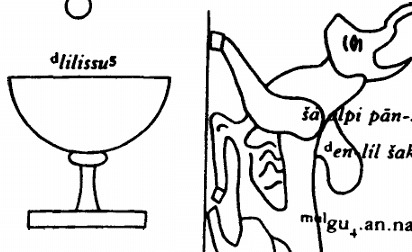
then the ritual of the kettle-drum (‘cave’!) , <<<
where this drum looks like ‘a goblet’ and remembering that Rgveda calls that
construct ‘the beaker’ it must relate to ‘the cup of wrath’ theme (-see page) ; [sic]
it does not say explicit ‘that the floor is in that drum’ here but the key figures
are Lugaldukaga (imprisoned stone) and Enmesharra (see above) ,
and remember “Lugaldukaga in the ritual-pit” at the Akîtu feasts ;
#5
where “Enmesharra hands over his sons”, read : they capture Eden base-7 ,
as “the 7 flames from the Sanctuary” that are to reach the floor ;
these turn into “the 7 defeated sons of Enmesharra” which however in
another reading are “minor goddesses of creation” : the bullied 7 Torches !
#6
these are defeated ,
when the “drum (wherein is the floor) is beating six times” (‘as matrix number’)
and the reason for ‘a drum’ could be ‘sound’ (‘frequency’) :
we have opted that the eden-floor also used ‘cymatics’ as ‘creating by sound’ <<<
where his light-particles ‘formed’ the desired creation , and hence ‘the drum’
[in Rgveda their ‘purified’ essence (‘Soma’) thunders, speaks and even cries]
#7
then ‘the 7 transformed (now matrix-) flames’ are mentioned
that relate to ‘matrix-Dawn’ and “giving matrix-life” to them demons and Torus ,
as Rgveda calls it giving life and the Sebek (millstone) chapter as ÂNKH-life ;
#8
then the light-particles themselves are ‘purified’ in another “copper drum”
(perhaps filled with-) “wool” — as a kind of ‘filter’ also described in Rgveda ,
resulting in “grease” as another term for the now ‘purified’ light-particles
[and also as in Rgveda that calls it ‘ghee’ (fat butter) which they love] ;
#9
then , “12 (!) bronze statutes are places inside the drum’ [sic]
in the form of 2 + 3 + 7 concepts , where the idea seems to be that the
light-particles will ’empower’ these concepts in order to be used by the matrix
and “as their strange math to come to their base-12” ;
here , the ‘two’ are ‘the Eden binary sun & moon’ as “the twins” and we had <<<
this theme both in Rgveda as well as in the Spells especially linked to ‘Zodiac’ ;
the “three” are ‘Enlil, Ea and Anu’ as their “triple matrix-realm” (Rgveda : Trita) ,
and the “seven” as their now ‘purified flames’ that are ‘creational aspects’ ;
#10
closing with ‘the bull skin over the drum’
but we have no idea – yet – what that is about , though Spells have a similar
concept as MESQET ‘the house of the bull skin’ ;
#11
then “their 3 crystalline realms” are described through ‘gem-stones’ ,
where the middle one (of mystery-Babylon) is linked to a dais (‘platform’ as
referring to the floor?) described as “glass and (as) crystal shine inside it” <<<
that immediately reminds of the qualities of the stolen floor (sic !) ;
serving us as proof that indeed the stolen floor had this goal for them ;
#12
then ‘the curse’ (also shown beneath the diagram) ,
where you & we are to vanish from the earth and eaten by dogs
[same type curse as in Rgveda about this theme and in Persia’s Mithra] ;
#13
then are set “lamentations for Enmesharra in Tebet” – the 10th month <<<
(where Enmesharra is eden base-7 and -10 with her ’10 month year’) ;
however this ‘lamentation’ is a mock ritual just like the mock-penance of
the king at the Akîtu feast , compare ‘crocodile tears’ ;
#14
and finally – for curiosity – “the ritual for a sick man (-on earth)” ,
showing how obsessed they were with this theme , projecting it upon an
earthly situation
please ,
all the above presented concepts based on much context are rather solid ,
though we still need to know what is the “bull skin” about and especially
the difficult “barley” (as Dumuzi aka Tammuz / 4th month) is about
[the latter perhaps best in a separate page] ;
all of the below is not so readable but serves as base for this summary
the ‘mystical explanatory’
all examples taken from
‘mystical and mythological explanatory works of Assyrian and Babylonian scholars’
with report-link (here)
the ‘stone’ as ‘demon’ and ‘as corpse’
this example to show hów difficult it is to obtain a solid theme about the floor ,
and though the exact reasoning remains unclear , the used terms together
can only be the imprisoned crystal-floor theme ;
first two descriptions please to make it a bit more readable ,
– the ‘Asakku’ (or Asag) was “a demon causing sickness” dwelling in the abyss (eden)
upon a mountain (‘coming from’?) & an army of rock-demons (perhaps the 7 Torches) ;
in context this demon must be ‘the light-particles (-as Eden’s realm)” emitted by
the next mentioned ‘stone’ — as the floor
(this Asag is not the same as the Anzu-bird , the eden-star) ;
– the ‘Zababa’ is tricky ,
but may represent ‘the stolen eden-sceptre’ (-upon the stone) , birthsceptre
[the axis Horus stole after Adam gave him base-10 of eden] ,
depicted as “holding a staff with the image of an eagle on top” — the eden star ! ;
but where his epithet probably was not ‘crusher of stones’ , as active ,
but “crushed óf (by) a stoNE” that is ‘by the matrix-millstone’ pressing the light-particles
out of the sceptre – as Rgveda has it ;
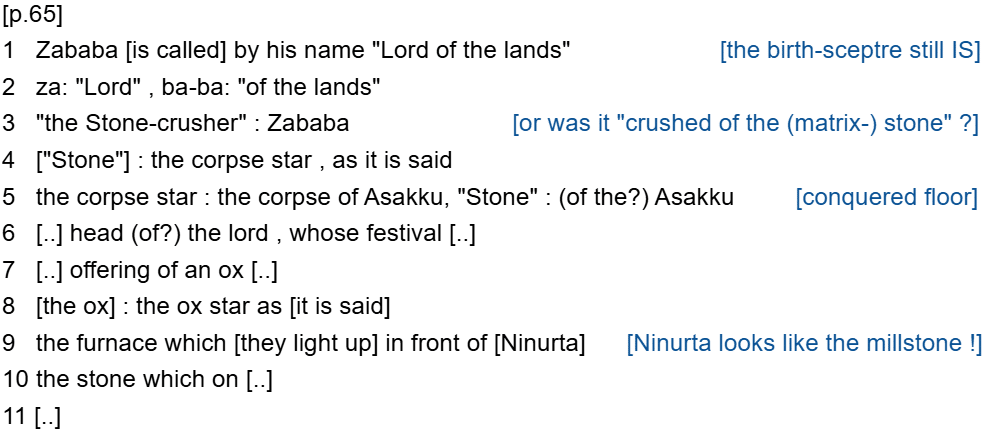
1 Nammu and Namse , the Apsu [..] [Apsu is the realm in their Torus]
2 the chariot which comes out (?) , seven [……….] [cave for (?) stolen base-7 / Torches]
[skipped]
here ,
Ninurta’s rival wás ‘the Asag’ (Asakku) “the light-particles (in Eden) by the floor”
and likely also intended “the ones sent-out into the Behemoth realm” (where they hid) ,
while the epic Lugal-e about Ninurta is full of ‘stones’ ,
where the ‘sagara stone’ is discared and the ‘kurgarannum stone’ [=himself?] as the diorite
esi-stone that will bring forth pretty statues in context as ‘bodies’, etcetera ; so that Ninurta
either is the millstone or ‘the now matrix-light-particles’ (Soma) ;
b)
the ‘chariot’ also shows in next one ;
[quote (p.66) :]
“…The other surviving lines relate events in cult practice to myth and astro-myth.
L.6 probably refers to a festival of Ninurta, but the content is broken away.
The next two lines link a probably cultic offering of an ox to the ox star or constellation.
This should be compared to the identification of the bull with the ox star in the commentary
on the ritual for covering a bronze kettle drum used in cult (see p.194).
LI.9 and 10 appear also to discuss cultic events.”
… the ‘kettle drum’ is either “the cave in which the floor sits” ór “the vessel in which
the light-particles are purified” (Soma in Rgveda) but what this has to do with ‘a bull skin
covering it’ (glyph MESQT in Spells) in page 194 ?
[p. 125]
1 The ox and the sheep which they throw alive to the ground …
That is Kingu and his seven sons when they were smitten. [eden base-7 & 7 flames]
2 The dove which they throw
They are throwing and splitting Tiamat.
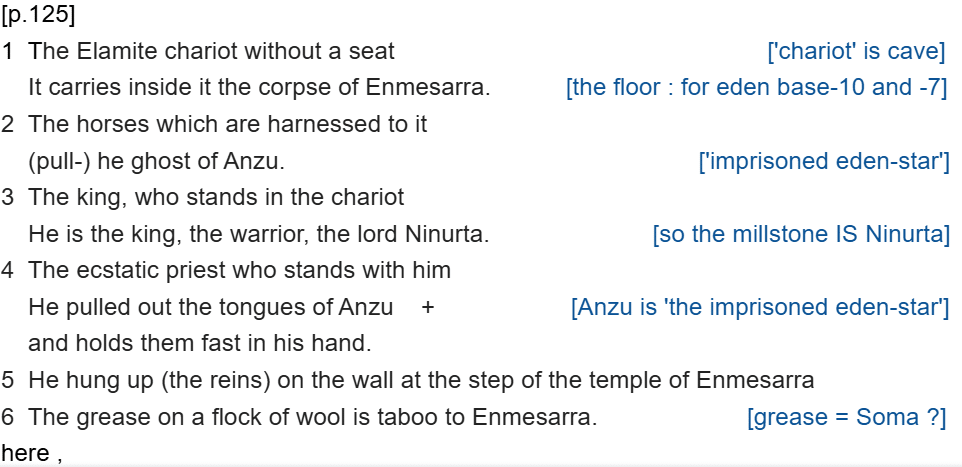
the “wool” in Rgveda is used “to filter the light-particles of the stone”
resulting in ‘purified particles’ as their Soma — the ‘grease’ here since Rgveda
often talks about ghee (fat butter) ;
a theme indeed as taboo for Enmensharra (light-particles by base-10 and -7) ;
b)
Ninurta is also called “the net of the gods” (157)
that links to the ‘net’ and ‘fishing spells’ in the coffin texts ;
[p.187]
THE PLACING OF BRICKS FOR DEITIES IN RITUALS [sic]
Rituals quite frequently require the placing of bricks for certain deities. In the ritual for
covering the kettledrum, discussed in the next section, a brick is placed for Lumha.
[Lumma ?
unknown – links to ‘guardian’ ; perhaps a “first-born concept” ?]
Another example is in a ritual for making a statue : [……….] ,
“You place the brick of Belet-ili [‘general mother-goddess’] and offer a libation over it.”
The context suggests that the brick alone is placed and represents the deity, rather than
being placed as a platform for the statue or symbol of the deity. A brick of the birth
goddess Mami, related to Belet-ili, is mentioned in the Epic of Atrahasis as having to be
in place for seven days when a mother gave birth.
This context is important. Firstly, it shows that the idea went back to the OB period
Secondly, the context in which it is used is that of the original creation of mankind,
by Mami. The idea that it was used then, and later, shows that every birth was considered
to be a re-enactment of the original one, when man was created by Mami, from clay and spittle.”
[here,
the ‘mother goddess’ MUST be ‘a personified form of the female Leviathan-realm’
where even ‘Bêlet-ili’ should relate to ‘Bêletiya’ as in the Nisan Akîtu ritual ;
while also the serpent-race of Rgveda calls Leviathan “my mother” ;
moreover in the hymn to Bêletiya she is called “the foundation” ;
then ,
not saying “that the crystal-floor is feminine” per se , but it HAS “seven female Torches on it”
where the construct ‘over the floor — the sceptre + his star — perhaps are ‘masculine’ ;
b)
also the hieroglyph dictionary has “birthing stones” (4 in total ?)
‘ritual for covering a KETTLEDRUM USED IN CULT’ [long :]
“This work comprises theological and mythological explanations of a ritual for covering a
bronze kettle drum to be used in cult. The reverse of the tablet gives a diagram showing
the required arrangement of gods, symbols, apparatus, the drum to be covered, and the
bull which is to supply the hide, in the chamber in which the ritual is to take place.”
[here,
the first page here is *totally unreadable” , but mark the bold ;
this must be ‘all the gods & aspects that are involved in this Ritual :

[impossible]
15 Ninurta. Sin and Nabu, the steward, (are) the
Angubba who at the command of Dagan have guarded Enmesarra since distant times.
[here,
interestingly “the floor” is directly linked with his “base-7 and -10” <<<
and perhaps ‘but now as matrix-nature , as Enki’ ;
b)
Lugalgirra & Meslamtea (in 8) : likely the eden-binary sun & moon ,
the were ‘divine twins’ (Mashtabba) ‘doorkeepers of the underworld [=eden] ‘ [wiki] ,
and in Mesopotamian astronomy they were a pair of stars as ‘the great twins’ ;
both needed here to make the matrix base-12 , later ;
c)
for ‘Dumuzi’ see ‘barley’ section at end of page
d)
Ereskigal may be “the south land” perhaps as ‘potentially ruled by Heaven’
and hence the strange ‘7 gates theme’ in the descent of Inanna epic ;
[or alternatively “the mid-region when still ruled by Eden”
where the author (in 201) has “Ereshkigal equated with Tiamat”]
e)
[source:] “an-gub-ba is a title of divine beings a meaning synonymous with “attendant”.
Note CT. 25, 2, 10, the five an-gub-bu of Eninnû ; [….] , an-gub-bi-e naṣir pirišti,
as “guardians of the mysteries.” […] Hence the gubba and angubba priests are diviners, seers.”
read : in Rgveda “the serpent (-race) existed of 5 races”
and it has here “Sin (?) and Nabu (Thoth) OF the 5 serpent-races” ; <<<
who “guarded eden base-10 and -7 since ancient times” ,
read : searching to overthrow base-10 and -7 and / or incorporate them ;
[a number of pages ago here it had “how the gods hid in the furthest regions”
which we know “was when the Eden realm had come into being”]
[cont.:]
THE ‘VAT FOR PURIFYING LIGHT-PARTICLES (-from the floor)’ (?)
as a virtually impossible theme —
from Rgveda we know that ‘purifying vat’ in which they ‘mix’ the light-particles <<<
from the stone with ‘their type’ , and here ‘a drum’ suggests “a beating”
(perhaps related to ‘sound’ because of ‘the frequency of the light-particles’ ?) ;
here ,
seven matrix-aspects are put in (?) the drum —
perhaps “as matrix aspects to which the light-particles have to cling to (mix with)” ?
[as ‘hands’ or ‘handles’ (author) ; or as “care / charge / security / pledge” :]

a) [wiki:] ‘Zisimmu , 7 sons analoguous to the Sebitti’ (the 7 flames)
and 10 here has “Zisimmu is Gula , the one giving (-sum) life (-zi)”
b) Angubba in 18 must be as in previous 15
c) ‘Sarur & Sargaz’ were a dual , to be counted as one ?
Sarur (Sharur) is Ninurta’s weapon – a 1000 fold mace ; <<<
Shargaz also seems to be a weapon , used the same time ,
as “a sickly being a lion with 50 teeth” > serpent-race related ? as 5 x 10 ?
d) that they put 2 extra , is this the origin of the (Egyptian-) Ennead (‘9’) ?
e) context suggests ‘they broke (-down) base-7’
f) the other names are impossible ;
don’t worry – it gets more crazy :
now the floor (Lukaldukuga) but it is not clear what is happening here :
the author (p.196) thinks that the main term was “marshes” and not “beating” ,
but ‘marsh’ is a typical matrix-concept and hardly pertains to the floor ;
so that considered the ‘drum’ and ‘frequency’ aspects it cán have intended “beating” :
as

[here,
perhaps the captured aspects are for (-Aralu) “the Field of Reeds”
as the mystery-Babylon paradise [if the interpretation of cources about ‘Aralu’ is correct] ;
and indeed ‘Enmesharra could weep because of that’ ;
but — there is a bizarre Spell about “speech weeping when it is mixed in the vat” <<<
and in the recent SEBEK spell showed a reference to ‘fish / tears’ REM ;
b)
but we don’t know why “6 aspects” – they left one out ?
or is this ‘making a 6’ (doubled to 12) we saw in the Ramses mural to make base-12 ?
[and “12” will appear here still !]
[next :]

[the author makes a side-step now and we follow :]
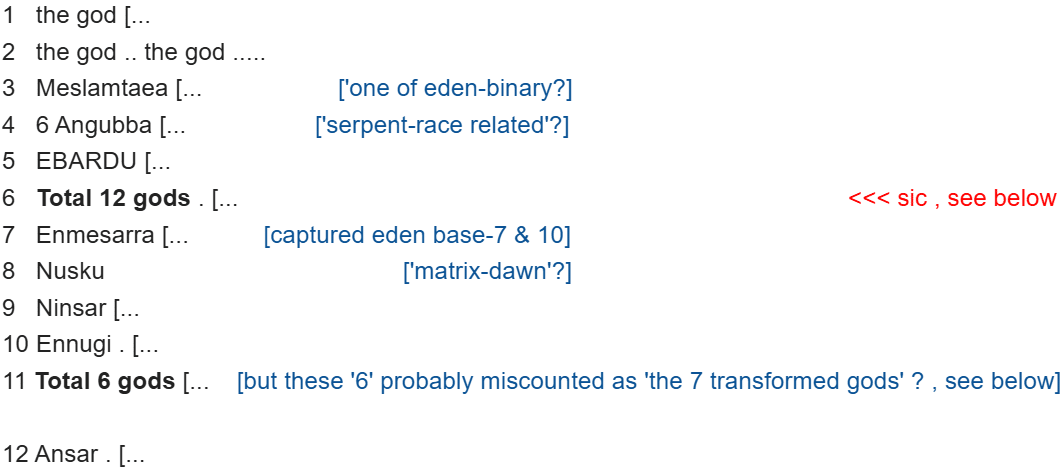
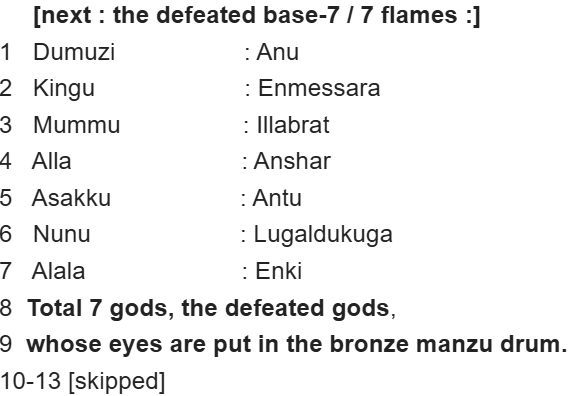
(in 200) he says that the list of these 7 defeated gods shows to right of the drawing
[there it has Asag (‘the light-particles by the floor in Eden’ / Eden-dawn) as Asakku here]
and perhaps 7 names were added to show “that those are now matrix-aspects” ;
next : the now 7 transformed (matrix-) gods :
[p.200]
3-4 zisumma (ninimma) , [who is in Nippur]
(ninimma , a birth / scribe goddess)
5-6 bigirhus (suzianna) , [of the Apsû]
(shuzianna , “one of 7 minor goddesses helping creation” – sic)
(bigirhus is like one of 5 serpent-races in Rgveda)
7-8 ennugi . [who looks after the fields]
(ennugi , minor irrigation male deity – can happen in several cases)
9 kusu , [the exalted lord]
(kusu , purification goddess, grain, linked to ‘a torch’ – sic – “dawn”?)
10 ninsar , [the son of esaba]
(ninshar , goddess linked to cooking , knife , artisan , to prosper)
11-12 ninkasi , [the son of a new city]
(“goddess of beer” as light-particles for physicality)
13-14 abarallah (nusku) [the son of the 30th when the moon dissapears]
[Ninmada ? , goddess linked to the serpent (race)
[here,
listed in wiki – but 1 missing : Ninimma, Ennugi, Kusu, Ninsar, Ninkasi and Ninmada ;
whether these are (soon ‘were’) sons or goddesses is not important for us ;
[p.201]
The seven gods, sons of Enmesarra, are heaps of flour.
You place the 12 bronze gods inside the bronze kettledrum,
and you cover the bronze kettledrum.
“Evidently, heaps of flour laid down during the ritual were regarded as representing the seven
sons of Enmesarra. This should be compared to the section of BM 34035 in which heaps of
flour represent Anu, Enlil, and Ea. The sons of Enmesarra constitute the third of the three groups
of gods referred to above, and listed in the ritual texts. The three groups are a total of twelve gods,
and these are presumably the same twelve who are to be placed inside the kettle drum before it is
covered. The ritual texts also provide the information that agubbu “basins”, are to be placed for
Kusu and Ningirimma, and a brick placed for Lumha.”
[here,
this must be their weird math to make their base-12 ;
(in 200) he has “three groups – of three, two and seven” together ’12’
[where the captured eden-binary (see earlier) was the “two” in this case] ,
here ‘as matrix-concepts put in the Vat to be energized’ as we posed above ?
the third group as “Anu, Enlil and Ea” (3 triangles p.194) as ‘3’ their “triple realm” ;
b)
the ‘agubbu’ perhaps is a basin of ‘pure water’ , set before Kusu
(purifying / grain / torch / dawn(?) and Ningirimma (‘lady of snake and fish water’)
perhaps as a combination of ‘(matrix-) dawn’ and ‘their dimension’ ;
c)
the ‘heaps of flour’ as ‘barley’ (Dumizu) theme is problematic ; see below ;
d)
the ‘brick for Lumha’ – perhaps he is a “first-born” concept b/c of the mace
or even a type ‘Osiris’ where the mace was the flail ;
e)
the “covering of the kettle drum” is the strange theme “with a bull’s skin” ;
in book of the dead spell as MESQET ‘house of the bulls skin ,
but we’ve no idea what is going on here ;
f)
also other sources have the ’12’ :
the “12 gods of my city, the tramplers of the storms” [1 in annex]
following after “the 50-fold mace” (see above) so both are ‘matrix concepts’ ;
it then has (p.58) “an invocation to the constellation Libra” (‘judgment’)
that is “followed by the names of 10 gods” (eden base-10) ; so that Ritually
they are judged , for then follow the 12 names – suggesting a type ‘countering’ ;
[legenda , p.203]
“Anu and Enlil are represented by triangles. Meslamtaea and Lugalgirra [‘eden binary’]
are on rectangles, one of which is explained as an altar.
Six of the seven sons of Enmesarra [‘the 7 transformed matrix-flames’] are represented
by circles and one, Abaralah, by a bisected triangle with its apex pointing toward the face
of the bull.
[abarallah was Nuska ‘son of the 30th day when the moon disappears’]
Remarks given in the diagram and around the edges explain what direction the various
protagonists are to face. The bull is to face Enlil.
The face of the kettledrum, Nusku, Meslamtaea, Suzianna, and Kusu are to face the West.
[so the cup’s mouth & 3 circles & rectangle (but as lugalgirra) face west]
Lugalgirra [=Meslamtea] , Ninimma, Ennugi, and Ninsar face the East.
[here,
perhaps they did this to secure “their West vs the East (to feed upon)” theme ;
cont.:]
In the lower right hand corner of the diagram is a list of deities explained as the seven
defeated Enlils [original 7 eden flames] , and these are to face a bronze manzu drum,
not indicated in the diagram but presumably used in the ritual.”
[here,
the manzu (MEZE) drum seems related to ‘mourning’ and ‘beating the chest (heart)’
and may denote “giving the (now defeated 7 flames) another frequency” ,
because ‘facing the drum’ means they were IN it ;
b)
the drum Lilissu to left must ‘contain the floor’ (as ‘the gloomy cave’) [sic]
and note the shape as a cup : in Rgveda it is called “the beaker”
and could be the same as ‘the cup of wrath’ theme (-see page) ; [sic]
(Brittanica com) says it was ‘a hand drum on a standard , like a goblet ,
usually played by women [2000 BC] and mentions ‘Miriam dancing and drumming’
[we ofcourse need to look at that since it follows the corrupt ‘Red sea crossing’] ;
this drum was covered with a red-dyed bull skin , what we don’t understand yet
[the author has ‘the constellation Taurus’ as the shown bull , in cosmological context
and here as “the bull providing the hide” ;
“the ritual is being interpreted as a mythological scene. The key figure is Enmesarra
[captured Eden base-7 and -10] . In I.25 of the obverse it is explained that the head
lamentation priest is Enmesarra. The sons of Enmesarra are identified with objects or
stages used in preparing the drum [..] . He himself, as Lugaldukuga (see 1.1), is also
identified with these objects or stages. The seven defeated Enlils facing the manzu
drum may be his sons, as would normally be the Enlil whom the bull faces. In […]
the sons of Enmesarra [‘7 now matrix flames’] are identified with relatively well known
deities and their mythological functions. Of these, at least the functions of Nergal as
knife-bearer [Nergal = matrix millstone fór the floor] and Ninkasi as cup bearer
[Ninkasi = goddess of brewing beer as ‘purifying the light-particles by the floor’
and “beer” as “(the demons-) also physically ingesting those particles”]
have a potential relevance to the ritual. The ritual is put in a cosmological context by
identifying the bull with the constellation Taurus.”
[here,
it does not say that the floor (Lugaldukuga) is IN the goblet
but indeed the floor & Enmesharra are tightly related ;
[p.204]
“K 4806 (see p.20i) states that the sons of Enmesarra are heaps of flour. Since a heap
of flour may well be circular, one can suspect that the circles on the diagram, marked
with the names of the sons, represent heaps of flour.”
[/end of ritual]
cosmology – crystalline regions
three regions are described (as the middle-realm between Behemoth & Leviathan)
but here the gods óf the subsequent realms seem to have been miixed up (?) ;
while in previous page 81 the diagram must not show ‘4 stacked regions’ but the
Apsu (Egyptian TUAT) is “the nature of their Torus the middle-realm”
(as ‘a mixture of eden and matrix realm’ only present in their Torus)
[p.83]
30 The upper heaven is luludanitu-stone of Anu.
He settled the 300 Iglgu inside.
31 The middle heaven is saggilmut-stone of the Iglgu.
Bel sat on a throne within +
32 on a dais of lapis lazuli. [‘dais’ is a platform]
He made glass and crystal shine inside (it). [sic , ‘fire in crystal’?]
33 The lower heaven is jasper of the stars.
He drew the constellations of the gods on it.
34 He settled the souls of mankind on the terra firma of the upper earth.
35 He made Ea, his father, reside on the middle earth. [..] .
36 [….] rebellion’ he did not distinguish.
37 […. ] He shut up 600 Anunnaki inside the lower [earth] .
38 [….] .. […..] of jasper.
1 [….] … Musu stone on the horn of Tiamat. [Tiamat is former eden mid-region]
Bel defeated her.
2 He smote her, establishing her destiny [now their mid-region]
and split her into [her] two parts like fish of the drying place.
3 The Tigris: her right eye. The Euphrates: her left eye. [unknown]
B) ADDITIONS
[from the end of the PDF where “the river ordeal” section is totally unreadable]
[p.256]
The weeping in Tammuz is for Dumuzi.
The illumination in Tammuz is a weeping for Lugaldukuga. [‘for the floor’]
The weeping in Tebet is for Enmesarra. [‘in the 10th month for eden base-7 & 10]
gi.dub.ba.a: writing stylus. Marduk, the true son.
Hands up: right. Hands down: left.
“The weeping for Dumuzi in Tammuz is well known. Weeping for EnmeSarra in Tebet,
or the preceding month, Kislim, is known from [….] ; it is explained that Enmesarra was bound,
and that Gula established a weeping for him […..] . The fifth line records a Sumerian idiom
for the left and right hands.”
[here,
the ‘weeping’ also is a mock-ritual (like the mock-penance at the Akîtu feast) ,
and interestingly connected to ‘(Eden’s-) 10-months’ ;
Gula is “the now matrix-purified-light-particles by the imprisoned floor’ (as ‘Soma’ in Rgveda)
and correctly juxtaposed with Enmessaara — Eden base-7 and -10 ;
b)
the ‘Dumuzi’ theme is a headache , perhaps related to ‘barley’ , see below ,
where in the previous section he was listed as “one of the fallen 7 sons” (7 Eden flames) ;
and why he is connected to ‘Tammuz’ as “the 4th month” is unknown ;
c)
[last line reminds of the pose of Pazuzu but who knows this is an invalid connection]
the curse
[next : this reminds of similar curses in Rgveda and in the Mithra-epos of Persia :]
[p.260]
A secret of the great gods. May the initiate instruct the initiate.
Let the uninitiated not see. Taboo of the great gods.
Written and checked according to its original.
[…….]
He who breaks this tablet or places it in water, or reads it,
one who does not know and should not be allowed to hear —
May Assur, Sin, §amas, Adad and Istar, Bel, Nabu, Nergal, Istar of Nineveh,
Istar of Arbela, Istar of Bitkitmuri, the gods of heaven and underworld,
and all the gods of Assyria, curse him with a foul and irrevocable curse.
May they not show mercy to him as long as he lives.
May they cause his seed to vanish from the land. May they place his flesh in the mouth of dogs.
[here,
this probably was not addressed ‘to (people of-) other nations’
but ‘to the souls originating from Eden’ whom they knew were around
(and compare the two killed figurines in the Akîtu festival in Nisan)
since this was written before or in the time that Jacob (as a people) came into being ;
curious : ritual for curing a aick man
adding this here becauseit shows how they were obsessed with the situation in the
other reality concerning the (stolen) floor now giving the Torus light-particles ‘of health’
as a situation they prejected upon ‘a sick person on earth’
(as a practice much later turning into (more) silly magickal healing rituals) ,
[p.173]
1 The gypsum and bitumen which they smear on the door of the sick man.
The gypsum is Ninurta. The bitumen is Asakku. Ninurta pursues Asakku.
2 The circle of flour which surrounds the bed of the sick man :Lugalgirra and Meslamtaea.
3 The three heaps of flour which they cast down. :Anu, Enlil, and Ea.
4 The design which they draw in front of the bed. :That is a net and traps Any Evil.
5 The drum and cymbals which are resplendent at the head of the sick man.
The drum is Anu. The cymbals are Enlil.
6 The standards which are set up at the head of the sick man.
They are Sibitti, the great gods, sons of Ishtara.
7 The scapegoat which is placed at the head of the sick man. Ninamaskuga, Enlil’s shepherd.
8 The censor and torch placed in the house of the sick man.
The censor is Kusu. The torch is Nusku.

the Apkallu gods [that ‘teached humankind sorcery etc’]
visit a sick man , in a similar set up