
| Lev.14 : Fall feasts : does Adam die on the 70th day [‘the 24th of the 9th’] as the day before the crossing over to Eden ? [no “leprosy in stones” here but “the imprisoned corner-stone” narrative where at the end shows a vague animal-sacrifice : as ‘Adam’ ?] – he dies when the floor (as base-10 and 7) returns – |
this will be a bit messy page ,
but since the theme seems to be ‘Adam dies’
ofcourse his sons have concealed this event
theme
… though the sceptre of birth-right (as the returned axis with his star) as base-10
is said to be our Attribute and especially because of the virgin daughter in the star ,
through the captured sceptre Adam could get to the floor – itself as base 10 – that
powered the sceptre by means of the sacred seven Torches dancing upon it ,
so that by this steal he had accomplished his ‘10- and 7-fold revenge’ that he swore :
wherefore it makes sense “that he dies once the floor returns” , does it not ?
however , Esau has carefully removed any connection between ‘Adam’ and ‘stone’
and in fact so thoroughly that it even surprised ús ,
and only because we now have the Revelation 21 (-page) we know what to look for
so that the buildup of this section (33-53) here must be the corner-stone theme which
Esau has turned into his story about ‘stones and mortar causing leprosy’ ending in a
kind of half-magickal ritual involving ‘birds to cleanse the leprosy’ —
yet for us important is that “an animal sacrifice” shows at the end here , as pattern , <<<
as confirmation that “it is Adam dying” just before the (base-10 and 7) stone returns ;
the point is not that leprosy (or elsewhere ‘a plague’) cannot have existed
but that Esau used it as excuse to conceal the stone theme : not only per key words
but also in phrases as “when you will enter the promised land” (34) followed by the
directions ‘against leprosy’ as a context that just doesn’t make Sense ;
combined with actions linking back especially to ‘Aaron’s sanctification’ (Lev.8 & 9)
which is important because that foreshadowed our own crossing over to Eden !
though the Locusts as Horus & co stole the floor – after they had cut off the sceptre –
they are not the subjects here but rather ‘Adam’ who sold Eden’s legal right to them
and this chapter is all about the return of the base-10 and -7 to Eden – with us ;
though the chapter is too corrupted to make a fully restored text there remained
enough interesting phrases to recompose a valid buildup
chapter notes
the ‘finger in blood & foundation of the altar’
at a certain type sacrifice “the priest had to dip his finger in the blood of the animal
and pour the blood at the bottom (‘foundation’) of the altar next to the entrance”
which makes very much sense in this context : the finger represents ‘base-10’ and
the foundation of the altar “the (burning) crystal floor” — where the animal can only
have represented ‘Adam’ and ‘the poured out blood’ for the crime he did to it ;
[sub :
context would demand “that the bottom of the altar next to the tabernacle entry
was made of 10 large stones” just like Joshua and his people built an altar with
10 stones (not ‘12’) when they entered the land , representing the returned floor
in the days of the end ;
but Esau must have removed this notion to not give us any ideas
[and please see the link with ‘the door of the Tabernacle’ , below] ;
however ,
this line does not appear at the end of this section , though it definitely shóuld have ,
and most likely because Esau from several chapters cut-off similar lines as this one
and ‘dumped’ them in Leviticus 4 (5x) so that they now have no context any longer
because disconnected from the ‘stone’ theme ;
we saw before how Esau created these type ‘theme cemetaries’
[the endless Joshua pages is a good example] ,
and in fact he did the same with the subject of this whole chapter section 32-53 :
though here the main subject still is “stone”, the “common leprosy” section (1-32)
originally was the very same theme (just without the word ‘stone’ in it) as here :
as was Leviticus 13 “a plague” , as was Leviticus 12 the alleged “circumcision” ,
and probably several more chapters sharing similar type key words — it but proves
that he went through great length to completely cover up the ‘floor & Adam’ theme
[sub :
wherefore “the 10 lepers” story in Luke 17 can have been about this ,
but as “the 10 of the house of Eden” represented by the stone , and indeed
one of them [=the stone] ‘returns’ to ‘the glory=sanctuary (!) of God’;
similarly the “mud on the eyes of the blind man” (John 9) must have been
about ‘the stone in the matrix mud-pit’ : there was no end to Esau’s hateful
corruptions and ofcourse it costs us time to see all of them]
waiting until the 70th day
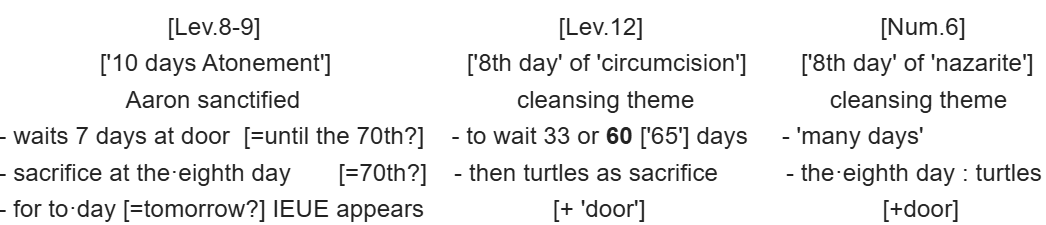
… after his sanctification (at Atonement) Aaron had to wait ‘seven days’ at the door
of the Tabernacle , and after that at ‘the·eighth’ (sic) day “he offers an animal” and
the line “for you will see the glory of IEUE” appears ;
but what if , after the ten days Atonement as one day for each tribe ,
the priest Aaron had to wait +60 days until the 70th , then making a sacrifice ?
in Lev.8 & 9 ,
it is never explained whý he had to wait , but the action suggests an important
juxta namely ‘going forth from it’ and in our case ‘going forth to Eden’ since the
sanctified Aaron in priestly garment (our Originals) was the foreshadowing of that ;
but then why (in chapter 9) at the·eighth day he again sacrifices ?
what if that sacrifice was ‘about Adam’ like here , and at the 70th day ? <<<
is a ‘70’ impossible ?
if the number of tribes of Ishral is ‘10’ showing in ‘the ten days of Atonement’
[of which Esau made ‘Atonement on the 10th day’] as base-10 of the Eden house ,
then why not combined with the ‘7’ as God’s number ,
akin to Weeks as 7 x 7 (days) after Passover and here as 7 x 10 (days) beginning
at the same time as the ten days of Atonement (akin to the week of Unleavened) ?
it matches the “24th of the 9th” as end date before the 10th month starts
[though then we would need to keep an Eden month of 28 days] ,
perhaps symbolically (or more) for the restored base-10 number
[sub :
we still have a ‘10’ : as ‘the 10th day just before Passover’ in which one of
two flocklings had to be chosen — where in the final Jubilee ‘Adam’ would
be selected as sacrifice ! moreover , this act “makes Adam a 10” where in
context perhaps this flockling was kept apart until this 70th day]
70 days — as ‘work’ , declaring (redeeming) the ‘10’ and ‘7’
… it may be that Aaron was asked “to do something” by waiting at the door ,
not unlike you & we have to work to restore all themes to can understand them
which in the Scroll is described as “go redeem the base-10 of the house of Eden” ;
while the number ‘70’ represents the 7 again solidly connected to the 10 ;
also ‘heads of tribes’ waited :
apart from Aaron as priest also ‘the heads of the tribes’ waited at the door of the
Tabernacle (-and later ‘of the gate of the Temple’) which is interesting for us since
it confirms that this action was a foreshadowing of the 140,000 sons & daughters
right now that eagerly wait to go forth after the 70th day — if we’re right in this ;
in Ezra 9-10 ,
after he discovers that they are commanded ‘to keep the 10-month year’ , [A]
like in Chronicles ‘they send out a proclamation though the land’ for the people to
gather together in Jerusalem in order to declare their keeping of the 10 months
[the theme is not ‘strange women’ but ‘the strange year’ of 12 months] ;
but the people gathered in the temple court are concerned , saying ,
(13-14)
“But the people [are] many, and [it is] a time of much rain, and we are not able to stand [=outside] ,
neither [is this] a work of one day or two: for we are many that have transgressed in this thing.
Let now our [=princes] of all the·assembly (!) stand (‘at the door’) +
and=for let all of them=us which have taken=kept the strange wives=year [….]
[=so that] the fierce wrath of our God for this matter be turned from us.”
here ,
though very corrupted the ‘‘10-month theme’ is rather sure
and remember they just came from Babylon so arguably they forgot about it ! ,
where also ‘the anger’ is part of this subject ; perhaps it said ‘one=seventy days’
and after that ‘the princes=heads of the·assembly = the (2) tribes’ , while line 9
shows a mutilated & misplaced ‘twentieth of the·ninth month’ , all together as
indications that indeed we have the 10-month theme here ;
where 19 has “… and [they offered] a ram of the flock for their trespass.”
which must be the same Adam-flockling ;
[the other example [B] moved to annex because too corrupted for here]
other examples :
interestingly the alleged ‘circumcision’ has an extra ’60 [-five] ‘ days waiting
and like in Num.6 ‘two turtledoves as sacrifice are to be brought to the door
of the Tabernacle to the priest offering them’ ,
conclusion
it is true that in the past two years we were wrong several times about our date
and though we knew ‘that we go when we found the final theme (of the many)’
only last autumn we properly understood about ‘the sceptre and his star’ ;
however , neither (the end of-) past December worked out ‘as the 70th day’
while since then we also came to properly understand the ‘floor’ theme as the
base óf the sceptre and star so that now the picture must be complete ,
and we still have one shot at that 70th day — in the final days of this January ;
though a personal thing ,
interpreting a date in July 23 when He was very close & kind as an event that
never got explained to be ‘the day of Weeks’ — which may seem a bit late for
the day of Weeks , pushing back Passover to May , but not impossible —
wherefore Atonement was halfway November ’25 in the seventh month ,
so that this January is not the tenth but the ninth month
Welcome to the Creator’s Calendar – The Creators Calendar
and we may hope for the final days of this month : if He still wants us that is ,
for the situation got so poor by now that even we wouldn’t take us
but let’s hope He is so majestic and kind like we knew in the past years
this section
(33-34)
“And the LORD spake unto Moses and unto Aaron, saying,
When ye be come into the land of Canaan, which I give to you for a possession,
and I put the plague of leprosy in a house of the land of your possession;”
here ,
it is nonsense while also the structure of the line was changed ,
the theme is ‘the people coming to Eden when the stone returns’
but then first we must have found him in the Scroll , hence the phrasing next :
(35)
“And he that owneth the house shall come and tell the priest, saying,
It seemeth to me [there is] as it were a plague in the house:”
next ,
now “the history of the stone” must follow , what happened to it ,
(37)
“…. reddish-ones = Adam (?) (admadmth=adm) (what Adam did ?) … ” [goto 40 :]
but ,
though this narrative continues (see below) Esau moved two lines to here to
build his own story line , in which ‘abide at the door’ and ‘seven[+ty] days’
are important components of this whole theme
[perhaps Esau swapped ‘the 7 Torches’ with these lines now] ,
but these two lines must have shown somewhere at the end , in the context of
us recognizing whý the priest (or the heads of the tribes) had to wait at the door ,
(38-39)
“Then the priest shall go out of the house to the door of the house, and shut up
the house seven days: And the priest shall come again the seventh day,
and shall look: and, behold, [if] the plague be spread in the walls of the house;”
as
[and they will understand why-] the priest was shut=stationed
at the door of the the·house = tabernacle for seven[+ty] days ;
39
and at the·seventh = the seventieth (sic) day … (now we need a sacrifice , see later on)’
here ,
in the real narrative at this point not “two turtledoves are offered” (in 59-50)
but “the second flockling [Adam] that was selected at the 10th before Passover” [continued :]
(40)
“Then the priest shall command that they take away the stones in which the plague [is] ,
and they shall cast them into an unclean place without the city:”
as
took away the stone ….
and cast [=him] into an unclean place outside the city=sanctuary ; [‘the matrix ‘pit of mud’]
here ,
the chance that this is nót the corner-stone theme is almost impossible ;
(41-42)
“And he shall cause the house to be scraped within roundabout, and they shall pour out
the dust that they scrape off without the city into an unclean place: And they shall take
other stones, and put [them] in the place of those stones ;
and he shall take other morter, and shall plaister the house.”
key phrases ,
[they-] poured out the·soil = clay (‘close’) roundabout [+him] …..
42
[=as] plastering the·house = the stone (Beth=aBn) ;
here ,
usually the ‘clay’ and ‘pit of clay’ appears in this context as does “plaister”
[which is ‘the sand’ in the Amduat book] ;
(43)
(unknown)
(44)
“Then the priest shall come and look, and, behold, …… “
this must have been ‘when the sons will have understood about the stone’ ,
because ,
(45)
“And he shall break down the house, the stones of it, and the timber thereof, and all the
morter of the house; and he shall carry [them] forth out of the city into an unclean place.”
as
[=then] the stone (will) break free [from-] the·house = the pit …..
b
and he (will) go forth to outside=inside the city=sanctuary (‘as in 40’) ….
but ,
from this point the continuation is tricky —
the ‘stone (almost) going forth’ is linked to ‘the priest waiting at the door’
but do we need the same reasoning and have lines 38-39 now ? [38-39 here ?]
(46-48)
(unknown)
CLOSING :
Esau consistently uses “two sacrificial birds” with this theme or even double
as “two turtledoves and two pigeons” (as in line 30) — but what did he see ?
was it “the animal sacrifice” AS Adam that will die and hence he made ‘two’ ?
while in the other case of “two turtledoves and two pigeons” the origin of the
animal was noted “as one of the two animals selected before Passover” ?
[also here shows 2 x 2 but concealed as ‘scarlet’] :
(49-50-51)
“And he shall take to cleanse [=for to make sin] the house two birds, and cedar wood,
and scarlet [=double-dipped] , and hyssop:
And he shall kill the one of the birds in an earthen vessel over running water:
And he shall take the cedarwood, and the hyssop, and the scarlet, and the living bird,
and dip them in the blood of the slain bird, and in the running water,
and sprinkle the house seven times:”
[rephrased :]
and (at the 70th day) he takes as sin [+offering] [+the one] of the two birds=flocklings
[=chosen before Passover ?] ,
and he kills (or ‘sacrifices’?) the bird=flockling …..
[… unknown …]
… the slain the·bird = adm-man (‘Adam’) (‘no match’) …
… the seven[+teeth] the·house = day (?) (‘day seventeeth’) …
sadly that is all ,
for there are no other words that stand out and the above is risky , already ;
several times in Leviticus a meaningful action shows , as “the priest dipping his
finger in the blood of the sacrificial animal , then pouring the blood therof at the
bottom (lit. ‘foundation’) of the altar” — where ‘the finger’ is “base-10” and the <<<
foundation is ‘the (burning-) corner-stone’ , and the blood ‘that of Adam’ having
given away the 10 of Eden ;
but Esau has dumped the instances in Lev.4 (5x) being contexless now ;
(51-52)
(unknown , can be anything)
annex :
a similar theme shows in the even more corrupted Numbers 11 , [B]
making it difficult to see whether this is during Moses’ time — or if it is prophetic ;
the core is ‘70 elders standing with Moses’ which could be “at the portal”
but then the question is ‘why Moses and not Aaron’ ;
concerning the ‘70’ : the idea appéars uncorrupted ,
supporting our ‘70,000 sons and daughters’ (and not ‘144,000’ from base-12) ,
where Esau’s main theme “eat – flesh” can be “die – to the flesh” so that at least
a section of this chapter is prophetic ;
(16)
“And the LORD said unto Moses, Gather unto me seventy men of the elders of Israel,
whom thou knowest to be the elders of the people, [=as] [=their] officers ;
and bring them unto the tabernacle of the congregation ,
that they may stand [=station themselves] there with thee.”
but , (24) ,
“And Moses went out, and told the people the words of the LORD, and gathered the
seventy men of the elders of the people, and stationed them round about the·tent (sic)”
perhaps ,
in (16) the 70,000 sons & daughters come into being ,
where in (24) we understand why “the priest had to stand at the [=door] of the tent” ;
but it’s all horribly corrupted while lines are swapped ;
in (22) a ‘herd is slain’ – the flockling as ‘Adam’ ?
(31) has “quails coming to the camp” – but is ‘stone will return to tsiun’ ?
and in (33) “the people are smitten” – which must have been ‘Adam’ ;
annex II :
[2023]
1st mnth 2nd mnth july aug4sept5oct6nov7
15th + 7 weeks = [2=n] [6=n] 7th of 3th month 15th [15=n] [45=n] +25
of 6th month [NM:5th] 29 January