
| final [theme] : the old-Babylonian ‘covering the kettle-drum with a bull skin’ ritual was ‘the removed covering of the Eden-star now for their ‘winged-disk’ copy [so that the disk with base-12 inside now could builds their matrix-creation because supplied by the “purified” light-particles by the imprisoned crystal-floor] [2025-02feb.17-19] |
[previous ‘Assyrian mystical texts’ page
was a good start – but has small mistakes]
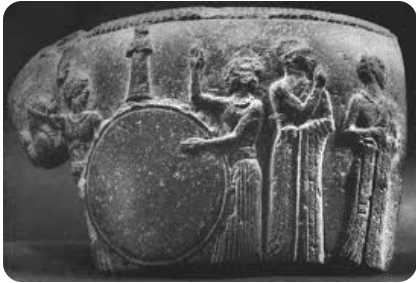
| …the theme gets more complicated by the day yet by carefully following all the aspects of this ritual we must — however absurd it may sound — conclude that this is about the Eden-star that wandered astray, which they captured in order to ‘strip him of his covering that made creation’ and place it over their made construct , and like holding a red cloth over your flashlight their “winged-disk copy” of corrupted light was able ‘to make a similar creational-covering’ for their Torus-construct and mystery-Babylon , and in this theme here , the slain bull represents ‘the Eden star’ where his hide is used ‘as a membrane for a drum’ that represents their winged-disk concept |
|
| yes at first the theme sounds very far-fetched , but the used symbolism is even lógical in part when you remember they copied the ‘set-up’ as it was in Eden where the star was powered by the crystal-floor of the Sanctuary — the now imprisoned floor supplies the corrupt (‘purified’) light-particles to the star but which are stolen from him by their winged-disk “star” |

there is no Mesopotamian depiction of this ‘skin’ theme since it was ‘a great secret’ Apis here is the crystal floor] |
theme
… the above lines are the conclusion of having done the whole – long – page below ,
and a number of aspects here also showed in previous ‘Assyrian mystical text’ page
but now we’re getting a better grip upon the many symbolical facets in these rituals ,
though the major themes still remain a mystery —
the good news is that indeed this is the eden-star theme for it links to ‘Anzu’ bird
giving the ‘life’ (ZU) that they need in the firm of emitted ‘light-particles’ which also
have a nature of “sound” : hence ‘the thundering and crying Anzu bird’ is described
[and remember Rgveda where the (even now ‘purified’) light-particles ‘thunder’ and
speak and recite , and even ‘weeps’] , as the theme “sound and vibration”
— are not ‘lightning and thunder and sounds’ emitted from the star (Ark !) in Rev. ? —
and hence their ‘drum’ theme : to regulate & command the light-particles
| yet many other things we don’t understand – yet : the ’12 bronze gods inside the drum’ is their base 12 root which they made from mixing theirs with Eden’s so that their winged-disk can make their Zodiac and 12-month year but we don’t understand ‘how’ [while “installing the year months” must ultimately be executed ‘through the eden-star’ , but now by their winged-disk feeding off of him] ; likewise with the bull skin : we don’t know “what is the outside of the star” that as ‘skin’ is removed , then “treated with oil & spices” then dressed around their winged-disk , even though that ‘garment’ (energy-field?) relates to the “creating a dimensional-garment” for a realm — hopefully soon we see what these things were about |
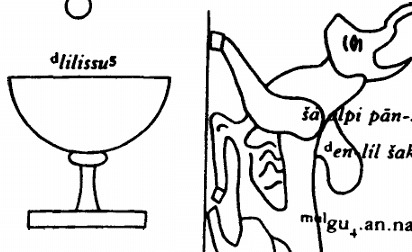
and Lilissu kettle-drum [the floor is in another drum] |
[please see upcoming page for the other type ‘drums’
representing concepts that supply this winged-disk /
eden-star theme for they built a whole theology on it]
[all from [1] in annex added with quotes]
[p.35]
“The very beginning is preserved only in the two Hellenistic texts where it is described in an
almost identical way. It is introduced by an enūma-phrase […..] ,
“When you want to cover a bronze kettledrum”, thus stating the primary intention of the
ritual. After the incipit this passage describes a perfect black bull which should be chosen
and carefully inspected. It must not have seven white tufts in the form of stars and must not
be struck by a stick or a whip. Another enūma-phrase follows , [………]
“When you want to let the bull enter the workshop” […..] ”
[here,
not sure why ‘perfect black’ – another source had “the multi-coloured (-skin) of a cow” ;
the restrictions sound like what Esau does with his ‘red heifer for the temple’ hoax ;
[and is ‘the workplace’ the same as glyph ÁS ?] ;
“The ritual tablets further indicate the timing of the ritual :
“(in an auspicious month), on a favourable day”. With the indication of time also the brief ritual
description on KAR 50 begins, mentioning “a proper month” “a good day” and a further remark
as “in the morning before sunrise”.
[here,
[2] has the ritual “on the 25th of the month Arahsamna” (8th month) ,
… the exorcists and the lamentation-priests perform (?) the ritual …. ;
[‘exorcist’ – as in the Akîtu festival – means “that Eden-aspects are involved !] ;
the timing makese some sense when the floor was stolen in the Akîtu of the 7th month
(Tishri) so that they now ‘complete their work’ ;
cont.:]
An instruction to prepare the workshop by sweeping, sprinkling of water and conjuring ends up
this section which is almost identical in both Hellenistic sources.
What follows is not that easily comparable since the wording is not so similar and the sequence
of actions is not always the same. Where TU 44 commands placing two bricks on each side of
the door of the workshop, an offering and a libation after which the bull finally enters, [another]
inserts a longer section concerned with 12 bricks.”
[the two bricks :
1. two bricks were set up on either side of the entrance to the temple workshop upon which
images of the deities Kusug and Ningirum were placed ;
[as Kusu (purifying / grain / torch / dawn(?) and Ningirimma (‘lady of snake and fish water’)
in the other page — perhaps as a combination of ‘(matrix-) dawn’ and ‘their dimension’]
2. Flour was to be scattered for the gods of heaven,
the gods of heaven and earth, and the ‘great gods’ ;
[again that ‘flour / barley’ strange theme , and see next :]
3. Two stands were placed in front of the two deities for the placing of offerings :
seven loaves of barley bread, seven loaves of emmer bread, a paste of honey and cream,
dates, sasqu-flour ; the thigh of a lamb, roasted, and a libation of beer, wine and milk
was to be offered ;
[the offerings always as “stolen Eden-aspects that had been transformed (-for ‘use’)” ;
the libation of beer [from barley] as ‘the now purified light-particles’ (?)
and the lamb thigh as ‘invertedd eden-axis’ (?) ;
after this ritual followed “the 12 gods one” (like in previous Assyrian page) as below :]
“12 linen cloths are laid on these bricks and 12 gods are supposed to sit on them […….] : [base-12]
the highest gods Anu, Enlil and Ea,
a pair of Lugalĝira and Meslamtea, [< the captured eden-binary]
and seven sons of Enmešarra.
The last group is here said to be represented by heaps of flour (ZÌ.DUB.DUB.BUmeš)
but the form of representation of the other gods is apparently lost in a fragmentary line.
These gods receive a variety of offerings : different kinds of bread, mirsu confection,
libation of beer and wine, sheep and coloured wool.”
[here,
they now make their base-12 (Zodiac) for ‘in’ the winged-disk ,
where the ‘wool’ reminds of “being the filter for the light-particles by the floor” ,
and the ‘beer’ as already ‘purified’ light-particles ;
that these gods are supposed to sit on ‘bricks’ (placed in a circle – as zodiac ?)
suggests “that they are birthed by the eden-floor” (and see previous page) ;
b)
the ‘flour’ has ZI “life” and DUB.DUB “to heap up, pile, pour” — but ‘from eden’ ? ;
“The incantation […..] mentions 12 bronze gods which are put inside the kettledrum
[as “winged-disk”] . It seems that the fragmentary beginning of KAR 60 might have mentioned
setting up water for these gods as well as their putting inside a bronze drum, while in KAR 50
only offerings to Ea, Šamaš and Asaluḫi take place.”
“Then both Hellenistic texts as well as KAR 60 tell us that a reed mat should be laid down.
Under it and at its sides the kalû [-priest] should heap up sand, the bull is supposed to stand
on it and his legs should be tied. [Then] the instruction directly follows to sprinkle the bull with
water and wash its mouth, surround it with a circle of flour and place a brick in front of it. […..] ”
[here,
the ‘sand’ looks like the sand as “stolen light-particles” in (Egyptian-) Amduat hour 5 ;
b)
the “washing of the mouth” as a kind of (Egyptian-) “opening of the mouth”
with the goal “to make it into a deity” and here “of matrix nature” ;
“TU 44 proceeds with drawing the curtains shut and finally with a performance of mouth washing
on the bull [……] . Interestingly, the strongly abbreviated description of KAR 50 mentions drawing
the curtains, but omits the mouth washing.
According to all ritual texts as well as the incantation tablet, two incantations are whispered by
means of a tube of sweet reed into the bull’s ears : “Great bull, choice bull, which treads on the
pure meadow” into its right ear and “O bull, you are a descendant of Anzu” into the left one.
In TU 44 the bull is sprinkled with cedar balsam , and only now purified by fumigation
and surrounded by a flour circle.
This text also mentions singing of an additional eršemma lamentation “Important one, you who
wanders about” and reciting a šuila-prayer “Great gods, who have created heaven and earth”
at the head of the bull.”
[here,
this is important for ‘Anzu’ was ‘the eden star’ [sic]
where the “as descendant” should mean “representing it” ;
the ‘reed in the ear’ is strange but perhaps “that the bull (skin) will obey their commands”
for to serve their winged-disk in making their “meadow” — their Torus —
and compare the “created heaven and earth” phrase ;
b)
the ‘lamentation’ was ‘the crocodile tears about a stolen eden-concept’ (see previous page)
so that here it must have said “you who wandered [=astray] ” – which the star indeed did ;
[from a tablet :]
“Bull, you are the offspring of the deity Zu [‘(stolen eden-) life’ , as in her star AN.ZU !] .
You have been chosen for the rites and ceremonies.
The deity Ningizidda [‘Thoth , sorcering the 7 flames’] is your friend for eternity.
The great …. , guard the (heavenly-) plans …. fix the scheme of heaven and earth”]
“Then the bull is killed and according to the Hellenistic sources its heart is burned with aromatic
substances in front of the kettledrum (LI.LI.ÌZ) or, interestingly, according to KAR 60 in front of
Lumḫa [‘Osiris type’?] [and elsewhere-] the kalû [-priest] is then supposed to uncover his head,
kneel down, stand at the head of the dead bull, and recite three times the prayer :
“He, who lies asleep” and three times refuse that he did this act: “these procedures the totality
of the gods has performed, I did not perform (them)”.
After that, he lifts up water and draws the curtains apart.” [‘invoking the other (matrix) reality’]
| [here, the “burned heart” is tricky : perhaps “the core (as heart) as cube (?) of the eden-star” was annulled – and ‘as cube’ like the Ark that represented him ; and in favour of the circle of their winged-disk — the circle as ‘the kettledrum’ ? like the Egyptian winged-disk features ‘a circle’ [as does ‘Horus sitting inside the round ouroboros’, same theme] so their own disk features the circle ; >> alternatively ‘burning the heart’ refers to the daughter of tsiun inside the star who is .. beeing disarmed (?) ; |

|
b)
the ‘cube’ vs ‘circle (or ‘orb’ but as their serpentine-form’) as forms for containing
conscious-energies [for lack of better phrase] we also had in the PyrText of the
star as square imprisoned in the BENBEN triangular pyramidion ;
c)
the “bull being asleep” means ‘being passive (-for to be commanded)’ ,
where the Spells use the same concept as ‘the enemy (eden) being asleep’ ;
“All the ritual texts join again and describe the preparation of the bull’s hide and covering the
kettle-drum with the soaked hide which gets fastened by the bull’s left sinew.
In the texts the head of the bull should face west and after its burial, oil should be poured on
the ground. KAR 60 does not mention any burial at all but includes a line that the galamāḫu
(the chief lamentation priest) shall not eat the meat of that bull.”
[or,
1. Remove the tendon of the left shoulder and bury the body of the bull
wrapped in a single red cloth ;
[it doesn’t mention any ‘pyramidal burying chamber’ (see above)
and the ‘red (cloth)’ is “the matrix-type red” – different as Eden’s ‘ruddishness’ ?
as prison ?]
2. Put some gunnu-oil on it and arrange it so that it’s face points to the West
[the ‘oil’ , unknown , linseed (?) ;
and “facing West” perhaps means “now sitting at the (dimensional-) matrix vector”]
or links to the ‘West vs East’ theme]
3. Take the hide of the bull and dip it in fine flour, water, prime beer and wine
and then lay it in the pure fat of a (?) bull and aromatic ingredients taken
from the hearts of plants, with four qa-measures of ground malt, and four
qa-measures of bitqa-flours ;
[so – the skin now becomes ‘the projector of their dimensional garment’ , <<<
and the ‘four’ perhaps as “the 4 stolen and added eden-cardinal points”
or/and the 4 cheribim vessels ?]
[2] has “ghee of a pure cow”]
4. press it with gall-nuts and alum from the land of the Hittites ; [?]
5. Cover the kettle-drum with the skin and make drum-sticks from mastu-wood …
tendon of the bull is used to hold the skin on the mouth of the drum.”]
[here,
the ‘sinew’ can be “a string” as of ‘a harp’ , related to ‘sound’ — because THE main
aspect of the light-particles , even when ‘purified’ , is “that they make sound” [sic]
[in Rgveda they ‘thunder’, ‘speak’, ‘recite’ and even ‘weep’] ,
hence they are commanded by ‘a matrix frequency’ through ‘the drum’ ;
“TU 44 is the only text which continues further. After the burial, it mentions some more offerings
to Lumḫa. Subsequently, in the third column a list of 12 gods with epithets follows. Only after that
one more ritual sequence takes place. Introduced by the indication “on the 15th day” [of the 9th ?]
the kettle-drum is said to be taken out to the sunlight (or to the face of the sun god).
This is the first time we can observe any change of place in any of the ritual texts. Offerings are to
be brought for Ea, Šamaš, Asaluḫi, Lumḫa (Lum-ḫa) and the kettledrum which appears with a
divine determinative this time (LILIZ).”
[here,
the ’15th’ day sounds like related to the “their month vs Eden’s month” theme ,
where “the matrix’ 14th day was their strong bull (‘strong concept’) as the opposite
of Eden’s and perhaps that is why this construct is now activated ;
b)
a source has “LI.LIZ , a ring (?)” different from previous LI.LI.IZ ;
so , if “those 12 gods” are involved and “the sun” (as ‘centre’?) linked to “time”
then could the “divine LILIZ” as ‘ring (?)’ is now officially their winged-disk ?
c)
while ‘the winged disk’ is strongly connected with ‘the sun’ (also in spells & Rgveda ,
where (see next) it is purified — but likely “anointed” — with a torch
(the stolen fire from the Eden-star which he vampires upon ?)
and he is ‘mouth-washed’ now “as becoming a deity himself” :
“The kettledrum is purified with a censer and a torch and with water from an egubbû-vessel.
Some kind of recitation follows and a mouth-washing, most probably upon the kettledrum,
is performed [………] . This is supported by one rubric on the Neo-Assyrian incantation tablet
which mentions explicitly “the mouth-washing of the bronze kettledrum” [….] . The kettledrum
is anointed and again purified by fumigation. The kalû [-priest] should literally take its hands
and lead it before the gods. Then the kalû sets the kettledrum up in barley seeds
and performs a lamentation named “The king, god of heaven and earth.”
[next,
the ritual is closing with the ‘curse section’ (and see previous ‘Assyrian’ page) ,
as :]
“Only a qualified person may view. An outsider that has nothing to do with the ritual
shall not view it … if he does, may his remaining days be few !
[but] an Informed person may show (this tablet) to [another[ informed person
[for] it is among the forbidden things of Anu, Enlil and Ea [‘matrix triple-realm Trita’] ;
[incantation :]
You are the Exalted Bull, created by the great gods. [< as ‘winged disk’ now]
You were created for the serving of the great gods …
in [=for?] the heavens your image … for the rites of divinity .
When the gods Anu, Enlil, Ea and Ninmah +
[decreed] the destinies of the great gods , [base-12 & stolen base-7 and -10]
your skin and muscles were destined for the secrets of the great gods.
Remain for everlasting days in this secret !
(O great gods,) fix the destiny [‘base-12’?] of this image with the gods, his brothers [‘the 12’?] !
As for [probably ‘BY’] this god may his temple [‘Torus’] be holy and purse !
May the evil tongue remain outside.
You shall perform the rite of washing the mouth.”]
II
[the ’12 gods’]
[the author now discusses the same PDF we did in previous page [see note 196 & 201]
so we don’t repeat that here – but proving the ’12 theme’ is indeed valid ; while in the
incantation above the ‘(12?) brothers’ probably refer to “the 12 (bronze) gods inside him”
as matrix base-12 by which he also furnished their ‘Zodiac’ and ’12-month year’ :]
“The so-called commentary tablet from Hellenistic Nippur is mainly concerned with the
enigmatic group of 12 gods which appears in the ritual texts, identifying each of them
with several other gods — and thus developing their numerous associations with a
certain kind of netherworld theology as well as with astral [‘astrological’] constellations.
Based on lists of these 12 gods included in the ritual text TU 44, in the incantation tablet,
in the ritual commentary and also attested separately, we can identify them [and see earlier]
as three groups encompassing Anu, Enlil and Ea, the pair Lugalĝira and Meslamtea and the
seven sons of Enmešara.
Furthermore, the commentary tells us that their names were recited during the ritual.”
[/end]
annex
[1] [main PDF :]
74788/DPTX_2014_2_11210_0_407429_0_163367.pdf
[2] [Linssen :]
www.google.nl/books/edition/The_Cults_of_Uruk_and_Babylon/71uJKgz7C58C?hl=nl&gbpv=1&dq=kettledrum+and+bull+skin&pg=PA94&printsec=frontcover