

| [theme] : ‘barley & wheat’ in ancient Greece – the Eleusinian Mysteries : Demeter the grain-goddess [form of NEPER] and the [matrix-] base-12 , her daughter Persephone representing ‘barley’ and the god Triptolemus [a ‘Mithra’ figure] as the stolen base-10 [linking to “the matrix-Spring” and even to the imprisoned crystal-floor] [2026-03mar.26-apr.2] |
| …we usually don’t do ‘the Greek religion’ as a watered-down version of the Spells but in this case some aspects are useful in supporting the context of the base-12 and especially “their secret” about this : all in all it became an interesting page : ) |
|
theme
… saying ‘only the context’ since these Mysteries were kept a tight secret
so that not much is known about their contents : but since their main venerated deity
was the grain-goddess Demeter and the theme ‘her abducted daughter Persephone’
we can reconstruct that the subject was akin to the grain-god NEPER in the Spells ,
and that “the great secret” links to the ancient-Babylonian rituals about their base-12
where outsiders were banned from – and even cursed for ! – just knówing about it
the Mysteries
[and wiki is good enough :]
“The Eleusinian Mysteries (Greek: Ἐλευσίνια Μυστήρια) were initiations held every
year for the cult of Demeter and Persephone […] . They are considered as the “most
famous of the secret religious rites of ancient Greece”. Their basis was a Bronze Age
agrarian cult and there is some evidence that they were derived from the religious
practices of the Mycenaean period. The Mysteries represent the myth of the abduction
of Persephone from her mother Demeter by the king of the underworld Hades,
in a cycle with three phases: the descent (loss) :
the search, and the ascent, with the main theme being the ascent of Persephone
and the reunion with her. It was a major festival during the Hellenic times, and later
spread to Rome. The rites, ceremonies and beliefs were kept secret and consistently
preserved from antiquity.”
here ,
you already can feel that ‘Hades’ is ‘Eden’ and because ‘Demeter’ (aka the Sumerian
beer-goddess Ninkasi – see page) is the same as egyptian NEPER which represents
the “barley light-particles (by the stolen eden-wheat) in the sky of mystery-Babylon” ,
her daughter ‘Persephone meaning “ear (-of grain)” either is ‘the matrix-barley itself’
or by extension representing “the matrix base-12” as the Zodiac theme ;
then ,
“Eleusinian Mysteries was the name of the mysteries of the Greek city of Eleusis ,
and may be related with the name of the goddess Eileithyia which likely also was
a counterpart with Elysium.”
but neither this is a mystery ,
for ‘Elysium’ is also known in the phrase “the Elysian Fields” which is the same as
the “Field of Reeds” in the Spells , as the matrix-paradise around mystery-Babylon
where their Greek town likely was named after their own paradise over there ;
its Rituals
as said not much is known about the rituals performed by the priests themselves ,
but also “a public festivity” was organized with the same theme lasting 10 days —
this is a Red flag to us ,
and the first question would be why not ‘12’ , the number of their ‘Olympian gods’
and as the ‘twelve works of Hercules’ (their base-12 theme) ? for reason that both
Diodorus Sicilus and Apollodorus say that Hercules was initiated in the Mysteries
in preparation for his descent into the underworld
[the ‘twelve works’ of Hercules is an extremely watered-down version of the 12 <<<
hours of Amduat (see page) wherein the matrix 12-month (Zodiac) year is made ,
where for example a ‘work’ like the “slaying of the Stymphalian birds” is the same
as the Anzu-bird theme in Sumerian lore — the eagle image of the Eden star ;
either way ,
to us, the connections show that the Eleusinian Mysteries were about base-12
the organized festivity for the people álso required them to be ‘initiated’
which most likely was just a formal thing since basically anyone could participate ;
and though during those 10 days a number of required rituals make Sense like
the offerings of barley (sic) many others do not —
so that either the people were clueless about the intent of the festivity (they were)
ór the organizing priests considered that “a few matching components” they did
were enough to connect the energy of the masses to the real goal ,
to sustain the matrix base 12 [-where the same repetition was required in Sumer]
at this point listing the contents of the event would deviate from the main theme
wherefore we added (the somewhat boring actions) by excerpts in annex at end ;

|

|

|
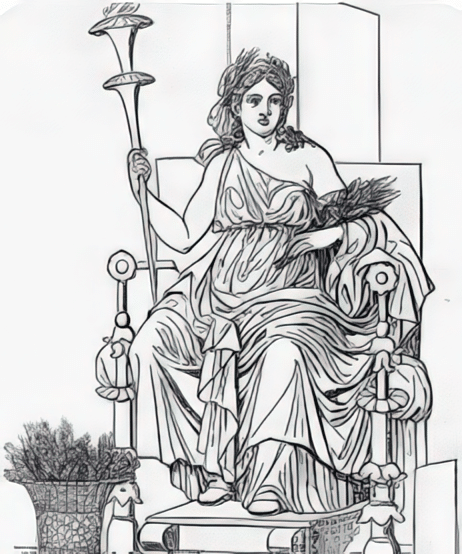
DEMETER
in fact there is not much to say about ‘her’ ,
but if you remember (Egyptian-) NEPER as “their barley light-particles in their sky” then
several descriptions make sense ;
“In Homer’s Iliad, the light-haired Demeter with the help of the wind separates the grain
from the chaff. Homer mentions the Thalysia as a Greek harvest-festival of first fruits in
honour of the goddess Demeter [in Iliad 9.534] “
here,
though it seems a stretch, this “separating grain from the chaff” we had as a similar Esau
line in the ‘wheat in the Gospels’ page where is said exactly that : but intended to denote
the difference between the matrix-barley and eden-wheat ;
so that here it says in a concealed way how she exists BY the (eden-) wheat
[while we still fight with the ‘(four-) winds’ theme] ;
then ,
“She was sometimes called Chloe (ripe-grain and fresh-green) and sometimes Ioulo
(ioulos : grain sheaf) [where] the sacrificial cakes burned on the altar then were called
the “ompniai”
perhaps the ‘ompnia’ was a typo for we cannot locate it (was it ‘omnia’ as ‘everything’ ?)
but please do note ‘the sacrificial cakes burned at the altar’ linked to our Unleavened ; [sic]
yet also this goddess had a dark aspect — read : a veiled connection to Eden ;
in Arcadia she was known as ‘Black Demeter’ wearing a disguise (sic) , and in Phlya she
was worshopped as ‘Anesidora’ who “is sending up gifts from the Underworld” as Eden ; <<<
also ,
“In Elis she was called Demeter-Chamyne (goddess of the ground), in an old chthonic
cult associated with the descent to Hades. At Levadia the same goddess was known
as Demeter-Europa and she was associated with Trophonius, a very old divinity of the
underworld. The oracle of Trophonius was famous in the antiquity.”
“In the mysteries (‘sic’) of Pheneus the goddess was known as Cidaria (‘crown’?) and
her priest would put on the mask of Demeter, which was kept secret (‘2x sic’). The cult
may have been connected with both the Underworld and a form of agrarian magic.”
here ,
we cannot know whether these Greeks “concealed the real story” or if they felt that the
official story had a deeper layer — but all of these make the connection back to Eden :
yet it’s difficult to establish whether their ‘underworld’ referred directly to Eden or to the
matrix-colony “the Orion region” trading the stolen aspects with the matrix realm ;
either way ,
the figure ‘Trophinius’ here is vague sounding like “a re-branded stolen eden concept”
(as the term ‘usura’ in Rgveda) and may be about their cave wherein is the eden-floor
yet much more interesting is the equally rebranded figure Triptolemus , next :
TRIPTOLEMUS
likely as base-10
… a number of attributes of Demeter are interesting like “her sacred grove” that we can
connect back to ‘the high places’ in the Scroll , but because these lack explanations we
cannot really use them ;
more luck we have with “Demeter’s chariot drawn by serpents” and since we’re looking
for ‘the Zodiac’ this chariot may represent that – as Rgveda describes it ;
however , the figure Triptoleus typically was shown
| as sitting on his chariot adorned with serpents , > depicted as a young man with a branch or diadem placed in his hair, with attributes as a plate of grain, a pair of wheat or barley ears (sic) and a sceptre ; where we go for ‘wheat’ or else this figure would conflict with the concept ‘Demeter’ ! he was central to the Eleusinian Mysteries and directly related to Demeter but the etymology of his name “triple” and “battle” or his other name Buzyges as “ox-yoker” can mean virtually anything ; |

|
yet if we start out with the idea that ‘he was the original (eden-) base 10’ given to [sic]
the matrix by Adam , but now “as the ten hidden stars (base-10) in their background”
per the book Amduat which they still use but as fundament fór their made base-12
which supports their (local-) Torus-construct as anchoring her into the Zodiac ,
then indeed Triptolemus is a re-branded concept ,
as “the warring Triple (-matrix realm)” called ‘Trita’ in Rgveda and “warring Eden” ,
where the “yoke” refers to the relation of base-10 with the now matrix base-12
add to this ‘the pair of wheat ears’ which is important for us since it directly links to
Eden while the sceptre should be ‘the stolen axis’ that IS base-10 : yet both as ours ;
where an educated guess concerning “the plate of grain” which he holds can be that
it is about loose cereal “representing light-particles” relating to base-10
[again , because ‘Demeter’ represents the matrix-particles just as NEPER does ,
and Demeter’s daughter ‘Persephone’ (below) represented their matrix-barley ears]
the myths
these are tricky because of inverted aspects and reasons ,
but the famous “abduction of Persephone by Hades” and then “her mother Demeter
searching her by also descending (sic) to Hades” is a long-winded myth intending to
say that both of them as concepts (-and by extention the matrix base-12 Zodiac) are
founded on concepts stolen from Hades (Eden) ;
hence during her descent Demeter “nurses Triptolemus” but which is an inversion ,
just as the section where “she is giving unto him a chariot that is drawn by serpents” ;
next ,
“Demeter taught Triptolemus the art of agriculture and shared with him how to go
conduct her rites and taught him her mysteries, and from Triptolemus, the rest of
Greece learned to plant and reap crops as he flew across the land on his chariot
wafting the wheat through the air to sow the crops across the inhabitied earth” ,
the mystery here ,
is how the base-10 light-particles — now imprisoned inside the matrix ones — float
in the sky over the field of Reeds as the paradise of mystery-Babylon by which the
demons there “can make existences” per the Spells as ‘creating many things’ ,
for the whole phrasing shows it has little to do with “agriculture in ancient Greece”
a couple of other myths about him we cannot use because unbased ,
but stressing his importance ,
“In the archaic Homeric hymn to Demeter Triptolemus is briefly mentioned as
one of the original priests of Demeter, as one of the first men to learn the secret
rites and mysteries of the Eleusinian Mysteries.”
“Triptolemus was said to be the ancestor to a royal priestly caste of the Mysteries,
who claimed to be Buzygae (Βουζύγαι), that taught agriculture and performed
secret rites and rituals, of which Pericles was its most famous descendant.” ,
yet here ,
read ‘ancestor’ as “the reason for the existence of that priestly class” ;
and from the link at end of page ,
“The Athenians,” says Hippolytus, “in the initiation of Eleusis, show to the epoptae
the great, admirable, and most perfect mystery of the epoptae : an ear of cereal
gathered in silence.” […….] The presentation of the ear of cereal was regarded as
a special, indeed the most important, feature of the Mysteries of Eleusis”
PERSEPHONE
… after previous ’10’ find this will only be a formality still , grin —
in Classical Greek art Persephone is portrayed robed, often carrying a sheaf of grain,
holding a sceptre and a little box however she was mostly represented in the process
| of being carried off by Hades (-see above) ; and Plutarch writes that she was identified with the spring season — which because she is ‘(matrix=) barley’ is interesting for us and links to the Sumerian Akîtu-festival that also méans ‘barley’ and was held in Spring to right : Greek Persephone-Isis but as a syncretic statue , holding a ‘sistrum’ which was of (Egyptian-) Hathor — at Orion — as the “winged disk” there linked to NEPER (because the matrix-barley-light-particles were emitted from their winged-disk , copied from the eden-situation where the golden wheat-oil was supplied to the star of the virgin of tsiun and then also emitted as particles into the (eden-) atmosphere [was this followable please ..?] |

|
so that the shown connection here is rather important for us — and see the pic in the
NEPER page where his boats arrive , on with two barley-stalks and one carrying that
sistrum ‘musical’ instrument for him ;
concerning her name ,
“The etymology of the word “Persephone” is obscure. According to an hypothesis
[….] the first element in the name (Perso- (Περσο-) may reflect a very rare term,
attested in the Rig Veda (Sanskrit parṣa-) and the Avesta meaning “corn sheaf /
ear [of grain]” . The second constituent, phatta, preserved in the form Persephatta
(Περσεφάττα), would be […] from the root *gʷʰen- “to strike / beat / kill”.
here ,
the term indeed shows in Rgveda and is the most probable candidate – per context
with the colour “barley sheaf” (or in the case of Persia (the ‘Iran’ occult Ritual today !)
probably their “spelt” , though the Negative difference with (eden-) wheat remains
[reminder note : search Avesta for grain theme]
that she linked “to the Spring” touches a still difficult theme for us :
so far , we reconstructed “that the matrix invaded Eden also in her seventh month”
in order to steal the crystal-floor and per context also both wheat-sheaves upon him ,
after which they devised their ‘12-month year’ (through them) which also started in
the (Eden-) Spring — though not at exact the same moment — because their barley
copy was based upon the stolen Eden-concept :
“The ancient Greeks told the myth of Persephone to explain the origin of the four
seasons (-through the myth of her abduction to Hades) , believing that the spring
and summer occurred during the months that Persephone stayed with Demeter
(read ‘in the matrix’), who would make flowers bloom and crops grow bountiful.
During the other months when Persephone lived in the underworld with Hades,
Demeter expressed her sadness by letting the earth go barren and covering it
with snow, resulting in autumn and winter.”
here ,
we’re not sure whether this refers to the intro or also links to ‘seasons of a year’
and we have to let this one pass since we don’t know whether Eden has seasons ;
the imprisoned crystal-floor
linked to the above is another myth featuring “a pig” ,
and only because of the Spells that call the floor ‘the pig’ as well (glyph -SHAU)
(-and a pig is also shown in hour six of their book of Gates , at the ‘throne-room
of Osiris’) we understand that here plays the same theme —
as
“When Persephone was abducted by Hades, the shepherd Eumolpus and the
swineherd Eubeleus saw a girl in a black chariot driven by an invisible driver
being carried off into the earth which had violently opened up. Eubuleus was
feeding his pigs at the opening to the underworld and his pigs were swallowed
by the earth along with her. This myth-aspect is an etiology for the relation of
pigs with the ancient rites in Thesmphoria and in Eleusis (‘of the Mysteries’).”
here ,
the ‘etiology’ means “a myth how their world came into being” (sic) and because
the “pig swallowed up by earth” sounds véry much like “the floor now in their cave” <<<
it indeed was the start OF their ‘Mysteries’ ;
the pig was not ‘of’ Eubelus but he , as one holding a torch , looks like “wisdom”
but here as “(matrix-) cunningness” in Spells álso showing with this very theme ;
next lines expand upon the above ,
as
“The Scholia to Lucian say that Eubuleus was a swineherd feeding his pigs at
at the opening to the underworld when Persephone was abducted by Hades.
His swine were swallowed by the earth along with her. The scholiast presents
this narrative element as an aition (‘see above’) for the ritual at Thesmophoria
in which piglets are thrown into a sacrificial pit (megara) that is dedicated
to Demeter and Persephone. Ritual attendants called “bailers” (antlêtriai),
then descended into the pit and retrieved the decayed remains which were
placed on altars, mixed with seeds, then planted. Pits rich in organic matter
at Eleusis were taken as evidence that the Thesmophoria was held there as
well as in other demes of Attica.”
bingo –
for it is the same ‘sacrificial pit’ theme as in the (Sumerian-) Akîtu festival !
the ‘pig’ was placed in the pit just like (Sumerian-) Lugulbanda was (see pages)
where instead of “pouring flour and honey and ghee in the pit” here a different
version shows but with the same meaning ,
because the ‘decayed original particles by it’ now fertilized their matrix-realm …
so that we have everything we need —
interesting still is a connection to ‘barley’ ,
“In his 1985 book on Greek Religion, Walter Burkert claimed [………] that the
earliest depiction of a goddess [was] Persephone growing out of the ground
as on a plate from the Old-Palace period in Phaistos, where the figure looks
like a vegetable because she has snake lines on other side of her.”
ANNEX :
Homer’s hymn to Demeter
though a long-winding read littered with deflections ,
and though a lot of possible key-words show (-what we always look for) but which
never are explained in a further context — and therefore remain unuseful for us ,
several phrases here are interesting
[from this link : www.uh.edu/~cldue/texts/demeter.html] :
– before her abduction Persephone plucks flowers ,
where the narcissus “has a hundred heads growing from the root up”
[an allusion to ‘the 100 and 1000 fold’ by base-10 ? , and see next :]
– as the flowers whose “‘sweet fragrance spread over the wide skies up above”
[sound like the concept in the Asenath page and ‘the anointment by Mary’]
– when Persephone gets abducted “Demeter searches her ‘ten days long”
[but ofcourse ;
then the story runs away into nonsense , probably on purpose]
– during her search some deity tells Demeter
how she “descended not from base parents but from noble ones”
[who says that ?
indeed ‘she’ comes from both barley-stalks but through the wheat-stalks]
– in 365 , where Hades is about to release Persephone , he says to her that
she “will be queen of everything that lives and moves about and you will have
the greatest tîmai in the company of the immortals. Those that will violate dikê
(‘cosmic law’) will get punishment for all days to come, as those not supplicating
your menos with sacrifice, performing the rituals in a reverent way, executing
perfectly the offerings that are due.”
[here ,
as the ‘wrath’ theme by the ‘not keeping the ordinance’ , in the Scroll ,
about nót keeping the Eden 10 months ;
and this ‘wrath / law’ theme also shows in the Mithra (‘base 10’) lore ;
here including a command that (Greek) people must perform the ritual ,
elsewhere said as “But whoever is uninitiated in the rites, whoever takes
no part in them, will never get a share [aisa] of those sorts of things [that
the initiated get] , once they die, down below in the dank realms of mist ]
– when Persephone asks to leave Hades]
he “gave her, stealthily, the honey-sweet berry of the pomegranate to eat”
[which may sound a stretch,
but since she is “barley” she feeds upon the eden-wheat as ‘fruits’ here ;
was the debile “Reuben and the mandrakes” in Genesis this theme ?]
– after a damaged section ? in 401 said to Persephone ? ,
the “but when the earth starts blossoming with fragrant flowers of springtime,
flowers of every sort, then it is that you must come up from the misty realms of
darkness”
B) rites during the 10-day ‘Mysteries’ festival
just a selection
[from this link : dn711001.ca.archive.org/0/items/eleusinianmyster00wrig/eleusinianmyster00wrig.pdf]
“Third Day.—On the third day pleasures of every description, even the most innocent,
were strictly forbidden, and every one fasted till nightfall, when they partook of seed
cakes and parched corn, salt, pomegranates, and sacred wine mixed with milk and
with honey. The Archon Basileus, assisted again by the four epimeletae, celebrated,
in the presence of representatives from the allied cities, the great sacrifice of the
Soteria for the well-being of the State, the Athenian citizens, and also their wives and
their children. This ceremony took place in the Eleusinion at the foot of the Acropolis.
The day was known as the Day of Mourning, and was supposed to commemorate the
grief of Demeter’s at the loss of Persephone. The sacrifices offered consisted chiefly
of a mullet and of barley out of Rharium, a field of Eleusis. Now, the oblations were
accounted so sacred that the priests themselves were not permitted, as was usual in
other offerings, to partake of them. At the conclusion of the general ceremony each
one individually sacrificed the little pig purified in the sea the night before. The hog
of propitiation offered to Frey was a solemn sacrifice in the North of Europe and in <<<
Sweden, down to modern times, and the custom has been preserved by baking on
Christmas Eve, a loaf or cake in the form of a hog.”
“Fourth Day.—The principal event of the fourth day was a solemn procession, when
the holy basket of Ceres (Demeter) was carried in a consecrated cart, the crowds of
people shouting as it went along, ” Hail, Ceres ! ” The rear end of the procession was
composed of women carrying baskets containing sesamin, carded wool, grains of salt,
corn, pomegranates, reeds, ivy boughs, cakes known as poppies, and also serpents.
One kind of these cakes was known as “ox-cakes” ; they were made with little horns
and dedicated to the moon (“cakes because of ‘months’ ?”). <<<
. Another kind contained poppy seeds. Poppy was used in the ceremonies because it
was said that some grains of poppy were given to Demeter upon her arrival in Greece
to induce sleep, which she had not enjoyed since the abduction of Persephone.
Demeter is invariably represented in her statues as being very rotund, crowned with
ears of corn, and holding in her hand a branch of poppy.”
“Fifth Day.—The fifth day was known as the Day of Torches, because at nightfall all the
initiates walked in pairs round the temple of Demeter at Eleusis, the dadouchos himself
leading the procession. The torches were waved about and changed from hand to hand,
to represent the wanderings of the goddess in search of her daughter when she was
conducted by the light of a torch kindled in the flames of Etna.”
(‘perhaps a stretch but ‘the 7 Torches now commanded by the matrix’ ?)
“Tenth Day.—On the tenth day the majority of the people returned to their homes, with
the exception of every third and fifth year, when they remained behind for the Mystery
Plays and Sports, which lasted from two to three days (“the ‘wrestling’ in Babylon ?”).
The Eleusinian Games are described by the rhetorician Aristides as the oldest of all the
Greek games. They are supposed to have been instituted as a thank-offering to Demeter
and Persephone at the conclusion of the corn harvest. From an inscription dating from
the latter part of the third century B.C. sacrifices were offered to both goddesses during
these games. They included athletic and musical contests, a horse race, and one with
the name of the Ancestral or the Hereditary Contest, the nature of which is not known,
but which it is thought may have had its origin in a contest between the reapers on the
sacred Rharian plain to see which should first complete his allotted task
(‘repeating the great steal of Eden-aspects ?’)
for you our Majesty