
[7 years ago & now as closing] while perhaps ‘at the 14th’ (?) ; keys in Esau’s ‘Rosh haShanah’ [version ; 2025-july-end/aug] |
| content : …though the ‘forty days till Atonement’ theme was good obviously we’re still here so that we have two options : chose to wait another 365 days (-we’ll be dead by then) or see whether the day of Trumpets can be a candidate , where the problem is ‘that she has no content’ or better her content has been erased by Esau — we learned ‘it was the start of the restored Scroll’ some years ago but can she have a followup in our situation ? now please , Num.10:1-10 shows “make – two – trumpets” but it can be corrupted from “two – events – át Trumpets“ … – part I : Esau’s “Rosh haShanah” : what did he know ? |
|
theme
… this whole date-thing really has become a trauma
and on top of that we we entered this strange state of “being like orphans” as a
new unexpected situation after the day of Atonement just ago turned out empty ;
so that we’ve no other option but to search for the next realistic possibility —
which is not “by placing Atonement back into the 7th month where it came from”
because the Weeks > 40 days > Atonement became too solid and must remain ,
wherefore — if we don’t want to wait another 365 days — we need to look what
can have been the original content of Trumpets and try to solve the problem of
how it can have connected with the solid Unleavened > Weeks > Atonement
theme since now she appears to stand apart from them
the attribute of Trumpets : ‘answering’
we knew that Trumpets was about the ‘I called and you answered’ theme where
our answering meant “the start of the Scroll’s restoration” which was symbolized
by the sons blowing the trumpet ,
so that in this analogy God may also answer ‘with a trump’ and that idea does
appear in prophets , alike this ,

arguably the problem is the Time buildup ,
where the divine ‘seven weeks’ followed by the ’40 days of sanctification’ makes
a sound whole , the eighty days gap after that does not ; and a possible idea
though perhaps stretched is that ‘Trumpets encompassed that time frame :

this is no semantica please ,
because the fractal in this way makes a good case for the embedded time frame
of Passover > Atonement as one whole — suggesting that ‘the extra 40 days’ as
Atonement following Weeks is rather solid (-instead of Esau having moved it to
place it in the seventh month) ;
while we now can also look for the possible cóntent of the “second” Trumpets
where it has to .. conclude something of the Passover > Atonement time .. no ?
Numbers 10:1-10 ‘two trumpets’
… first why it could be ‘two events’ :
(2)
“Make thee two trumpets of silver; of a whole piece shalt thou make them :
that thou mayest use them for the calling of the assembly ,
and for the journeying of the camps.”
this idea appears nowhere else and is corrupt by context , but two events can
have been the original idea — if it indeed has said the crucial ‘two’ , ofcourse ;
later on we’ll make an attempt at these lines but (4) is interesting for it has the
‘thousands=remnant of Ishral – gathered (!) at the one (trumpet-) blast’,
so that per context ‘the first blast’ can have been “the restoring of the scroll” !
the word ‘one’ shows in one of both juxta lines here (-and probably deleted
from the other line) , so that originally it can have shown “the one … the one”
which we would phrase as “the one … the other”
before diving into Esau’s version of Trumpets ,
Ezekiel 40:1-2 uses a phrase “the head of – the year” which Esau adopted as
his name for Trumpets ‘Rosh haShanah’ , and after that date-indication (in 1)
Ezekiel is “taken to a very high mountain’ : ofcourse it’s all totally corrupted
so that the theme must have been ‘the remnant taken to mt. tsiun’ as Eden
which supports the original idea of the Numbers 10 section
Esau’s Rosh haShanah
it lasts two days
… the official explanation is ‘because the witnesses may not have spotted the
new (empty) moon at the first day , so to be sure a second day was added” ;
but the whole new-moon spotting is nonsense since the month starts with the
full moon anyway (-see page) ;
point is that Esau needed a Ritual Link to this day in the form of that ‘double’
as the first Trumpets concerning the Scroll and possibly this one ,
and though no direct proof it can suggest that he tampered with this feast ,
not only with her content but probably also with her date
this feast as ‘the head of – the year’
… allegedly it is the meaning of ‘Rosh haShanah’ as the start of an invented
(civil) calendar next to the already existing religious one ; yet the same root
(-rsh) also means “important, main” and because he saw this day as one of
judgment he can have intended “the important one (‘feast’) of the year”
as a day of judgment
… in his main prayer on this day , the ‘Untanneh Tokef’ ,
On Rosh Hashanah it is written
and on Yom Kippur (‘Atonement’) it is sealed –
Who will live and who will die;
Who (will die) at the end of his days and who (before) the end of his days;
Who by fire and who by water;
Who by sword and who by beast;
Who by hunger and who by thirst;
Who by earthquake and who by plague
Who by strangling and who by stoning…
But repentance, prayer and charity cancel the harsh decree.
now ,
the judgment theme is clear here (though he moved the day of Atonement
so “that it will be sealed at Atonement” is not true) ; but interesting for us is
that phrase “.. to cancel the harsh decree” — because that must have been
about himself by God having said something that he is afraid of ;
praying to Adam
if you read carefully you see that Esau prays ‘unto both God and Adam’ :
in his Yom Kippur (‘Atonement’) liturgy it goes like this : first he addresses
God — not ‘praying to him — but quoting (his own corrupted) lines from the
Scroll but with the intent to steal the specific theme in question ,
then in another (type-) prayer ‘the King of the Universe’ that is ‘Adam’
is invoked as the one that should grant the real request —
and though he calls his Yom Kippur “the closing of the heavenly gate” but
closing Eden for ús , he asks Adam “to keep the gate OPEN” because this
is about ‘the northern gate’ of his circumcision ritual (-see page) !
likewise he does here —
after the above “cancel the harsh decree” in his next follow-up type prayer
called Avinu Malkeinu (where -mlk ‘the king’ is ‘Adam’) ,
it has “Our Father (sic) , our King , tear up the evil decree against us” ;
and since not both can be true the subject giving the original decree is God !
wherefore Esau prays to Adam to not have God judge (both of-) them !
the ‘Rabbi Amnon of Mainz’ story
… he invented many stories (like ‘the Maccabees’) covering (up) the by him
corrupted themes , where this ‘rabbi’ story links to Trumpets :
In medieval times a rabbi lived in Mainz (Germany) as friend of the local prince
that was a Christian. But it so happened that the ruler wanted to convert him ,
so that the rabbi asked him for three days to think it over.
But after those expired the ruler was angry and had him brought to his castle
accusing him of ‘being late with his response’ and therefore had his feet cut off
because ‘he had not hurried to come tell the answer’ , then also had either his
fingers or hands cut off (but the reason is not told) .
The rabbi with his severed limbs was brought home by his friends on that same
Rosh haShanah where he still could dictate the (above) main prayer to his own
congregation before he died ; and the legend tells that later he appeared unto a
colleague in same vision , asking for this prayer to be recited every year .
here ,
the ‘answering theme’ (of Trumpets) is still visible and the ‘three days’ may have
been “the three years of restoring the scroll” because of the buildup of the story :
the ‘prince’ is you & we , who were “friends” with Esau as long we kept reading
his corrupt scroll (-remember how he made Jacob & Esau ‘friends’ in Ex.31 !) ;
but then the prince “turns against him” for a period of three years , where the
conversion is about ‘the restored scroll’ that will end in his judgment which
IS ‘the evil decree against us’ ! as decreed by the real Scroll !
hence ,
the aspect of ‘the fingers or hands’ is unclear but múst relate to the scroll since
God uses the phrase “the scroll restored by your hand (‘doing’) but the same is
true for corrupting it . and Esau knew that phrase since ‘the scroll’ was Esau’s
main obsession ,
wherefore this story is a Defensive Ritual about what not must happen namely
the evil of ‘the restored Scroll’ by which he will be judged : ON Trumpets !
as the day of judgment – for him – through the evil decree !
for us this is important : IF it’s true that this was on his mind after having read
the original Scroll concerning this buildup , then he must have concealed this
same theme accordingly within her : in Numbers 10 and elsewhere ,
simply because he was terrified that this day would ever come to pass !
his own ‘Talmudic’ teaching shows that same ‘judgment theme’ :
that on Rosh haShanah three books are opened [in heaven] ,
the book of Death wherein the wicked are inscribed , the one of Life for the
righteous ones , and one in which the in-betweens are inscribed that later
(at his moved Yom Kippur) will be added either to the one or other book ;
[sub :
this rabbi story must have been an important truth for him since the core of
it already appears in the Cairo (Egypt) Geniza as a collection of the history
of jews since the 6th century , so that this story was another adaption ;
and note how ‘the request to the rabbi’ was ‘starting this yearly occult ritual’]
readings
… on the first day readings about “prayers for children being answered” (sic)
as the “Hagar & Ishmael” and the “Hannah” one — though we didn’t finish the
first one yet it’s about “the son as the protégé of Adam holding the birthright”
while the Hannah story (about Samuel) looks very corrupted since it looks as
if it was “the consecration theme” linked to ‘birthright’ (getting an only son) ;
while on the second day ,
about ‘Abraham finding the ram as sacrifice’ – which was about ‘Adam’ that
will be the sacrifice in the final Jubilee year (sic ! also “at Trumpets” ..??) ;
and , ofcourse ,
the inevitable “circumcision (-of Isaac)” theme of his (-see page) so that the
three most important aspects seem to be covered within this Trumpets Ritual
continued : ‘100 trumpet blasts’ at his Rosh haShanah
… then the trumpet blasts themselves —
we’ve no interest in following his childish reasonings why their number has to
be thrice 30 plus 10 and when exactly they have to be blown — all we care is
to find out what he covered up again , here :
the final one of 100 blasts
… if you know where to look for sóme ‘explanations’ can be quite interesting
for us like the reason for the 101th blast – ours in bold , taken from [1] at end ,
as ,
“It is customary to sound a long blast as the concluding sound of the shofar
in order to confuse Satan and prevent him from accusing Israel of lacking
fear of Divine judgment because they eat a festive meal after the services.
When Satan hears that the shofar is sounded
more times than the Torah requires , (sic)
he becomes confused and is apprehensive
that the additional sounds might be that of the shofar of Mashiah (sic) .
But is it possible that Satan, the fearless accuser of Israel
who is capable of setting clever traps for mankind , (takes one to know one)
is so foolish that he is frightened of a sound
that even a child knows is not the sound of the shofar of Mashiach ?
We learn that when the people of Israel hear the shofar sounded on Rosh
Hashanah they are brought to a level wherein they are indeed capable of
bringing about the final redemption . When they sound the shofar in
fulfillment of the precepts of the day, their closed hearts are opened, they
regret their sins, and their thoughts turn to repentance.
Satan knows the power of the sounds of the shofar : (sic)
though they might originate from man’s lips , (sic !)
they can well culminate (sic) with the coming of Maschiah”
now please ,
— the fact that he links Trumpets with ‘the return of Christ’ is rather major ,
even in his case he refers to ‘Adam’ ofcourse — his anointed one ;
— but note the stolen (!) idea of ‘how that happens’
by (his) people ‘doing something’ culminating in that ,
which can only be (a mutilated concept of) ‘restoring the Scroll’ !
since we saw above that “the sons blowing the trumpet” IS that start !
then the strange line ,
having “(sounding-) more times than the Torah requires” : she doesn’t say that ,
and IF she had mentioned “more than one blast” Esau has erased it from her ;
but either way his ‘more than 1 blast’ again suggests ‘a double-event’ !
the same theme returns here ,
“… the reason we make the blessing “to listen to the sound of the shofar” as
opposed to “to blow the shofar” or “on the blowing of the shofar” is because
one fulfills one’s obligation by listening to the shofar, not through blowing the
shofar.” [1] ,
the “listening” in our case can refer to “a dimensional ‘trumpet’ sound” !
the Esau sons ‘answer’ Adam (-with the shofar)
… because the genuine answering concept he moved to his own camp ,
per the “we use the shofar reminding of the ram trapped in the bushes after
Isaac was nearly offered” [1] where however in this corrupted story ‘the ram’ was
their father Adam as the sacrifice in the final Jubilee year ;
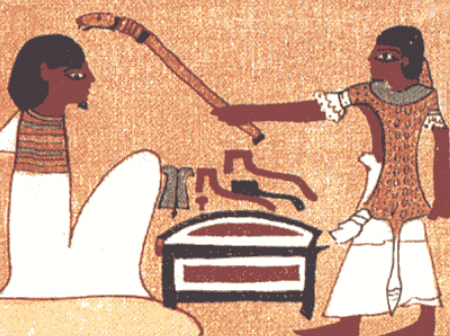
| [sub : perhaps our interpretation is too much here but since it’s Esau it may be accurate : “A curved ram’s horn is preferred because [……] its curvature reminds us to ‘turn’ (literally bend) our hearts to G-d in prayer and repentance.” to right : the curved UR HEQAu sceptre “of Sorcery” and not some much ‘of great (UR)’ sorcery but sorcery ‘through (matrix-) great speech” which is equivalent to ‘sound’ (shofar) as reenacting his own ancient-Egyptian Ritual (also see ‘the opening of the mouth’ page) |
|
at ‘what time’ Esau blows the horn [-and there’s a catch !]
… this is important please —
in our case , we have “Trumpets as one day” – from evening unto evening –
but because it is ‘a double-event’ this must be symbolized with trumpets ,
perhaps “as one trumpet sound after sunset and before néxt sunset” :
as ‘the start of Trumpets’ – the restored Scroll ,
and ‘the end of Trumpets’ – when we would héar the large trumpet ;
would that make sense please ?
therefore ,
immediately the decrees of Esau’s rabbis are suspicious [1] :
“The Mishnah states: “the entire day is kosher for the mitzvah of shofar,”
implying that one cannot perform the mitzvah at night. The Talmud derives
this from the verse:“a day of sounding it shall be for you” [=in the Scroll] .
While anytime from dawn and onwards is considered daytime,
the Mishnah states that one should only perform the mitzvah after sunrise.”
why ?
it sounds (pun) that Esau doesn’t want it to be blown at the first day !
then follows the “explanation” [1] :
“This is because some may erroneously believe it to be dawn when it is in
fact still night. In order to avoid possible mistakes, the Rabbis cautioned
against sounding the shofar before sunrise.”
bull , ofcourse ;
then the “proper time of blowing it” – at the end of the day of Trumpets – is being
consolidated by connecting it to his type-prayers-unto-Adam :
“The shofar must be sounded before sunset. This is because we are unsure
if the time between sunset and nightfall is classified as day or night. As such,
if a person did not perform the mitzvah before sunset, he should blow the
shofar after sunset, but the blessing is not recited.” [1] ,
telling here ,
is that there IS ‘a blowing after sunset’ ,
which however he linked to the end of Trumpets – not her start as the evening
before when the day itself begins !
so how can we know it was blown the evening ánd next day before sunset … ?
the fall of Jericho — trumpets the 1st day and the 7th [Joshua 6]
… though we still need to check the context here ,
where Jericho can be a foreshadowing of ‘the fall of Mystery-Babylon’ since
it was situated right at the border of the promised land — ‘of Eden’ — while her
name “moon” can refer to Adam’s hateful gate there ,
it has “at the 7th day when the trumpets blew her walls crashed down” where
per the buildup of events (see below) the first day was ‘Trumpets’ wherefore it
is not logical ‘that they blew trumpets every single day’ when going around it
but only at the first and last day ;
now please ,
if we keep that this was a foreshadowing of ‘the restored scroll’ that began
at the start of Trumpets , then ‘7 years’ can be ‘the seven days’ here until
Mystery-Babylon is judged — the theme of Trumpets that Esau so fears ,
as the day that ‘Rachab and her family escapes that city’
so that she was NOT ‘some prostitute’ because she represents our Originals :
then do we have a case for Trumpets as ‘double-event’ ?
moreover ,
[sub :
we only need the proper idéa here for the embedding can have been altered ,
or , alternatively , Joshua 5 can have explained this event as a foreshadowing
of the end-time when the real promised land would be entered ! :
because chapter 5 seems unrelated ,
but also shows the corrupted buildup of the feasts :
(6) ‘forty years’ [=the +40 days theme]
(7-8) ‘circumcision’ [=the corrupt Atonement theme]
(10) ‘fourteenth day of the month’ <<<<
they kept the·passover (tampered !) [=kept Trumpets]
(11) ‘the selfsame day‘ (!) [=double-event , pt II below !] <<<<
(11-15) ‘the captain of the Lord’s host’ [=Christ]
you see it’s possible ,
but it will be hard to properly re-integrate ‘Jericho’ with this chapter ;
however , the ‘entering the land’ represents Eden so we are with Trumpets
now and NOT with ‘Passover’ since that was at leaving Egypt !
the “forty years desert” they just had was an extension of Atonement theme
but as punishment —
yet just before entering the land , the Covenant was re-dedicated at mt.Nebo
after which the 12 spies searched the land for 40 days : as the period until
Atonement since those 12 ‘were purged’ because some of them did not trust
that God would help them – as ‘the consecration of the 144 theme’ just now ;
now ,
we cannot próve (yet) ‘that they waited 80 days after that’ until Trumpets
[but who knows they had to furnish implements of battle or something ?] ,
yet ‘the fall of Jericho / mystery-Babylon’ should link to Trumpets’ …
concerning this story ,
Esau may have altered her structure :
indeed “trumpets must have been blown at the first day” but only “the people
going around the city” makes little sense because that doesn’t fit the theme :
perhaps they went around it but only ‘representing the time frame’ ,
while the two spies were inside the city because they were a foreshadowing of
you & we who found out Mystery-Babylon ánd our Originals imprisoned in her —
what the story exáctly was is not even that important (!) ,
as long as we have the theme of ‘a double-event on Trumpets’ maintained !
the second blast (before sunset) : only in a Jubilee (?)
… since God had picked up the time line again after their reconfirmation at
mt.Nebo and Atonement following her , while the action now is “entering the
good land – as the promise óf the Jubilee (-theme)” ,
it is possible that the second blast only happened in a Great Jubilee Year —
in the same chapter 6 ,
after (4) “and the seventh day the priests shall blow the trumpets” ,
(5) has “and·he-becomes in·to-draw-forth-of ֶin·horn-of the·jubilee
as·to-hear-of·you sound-of the·trumpet
they-shall-shout all-of the·people shout loud
and·she-falls wall-of the·city” ,
[=then] (will) come to pass +
b
[..] the draw=start (?) of – [..] the horn=year of – the jubilee (‘rams horn’) :
c
[=when] you (will) hear – the sound of – the·trumpet = the rams horn (‘from heaven’?) ,
d
all – the people – (will) shout=rejoice (?)
Esau doctored here :
the priests already blow the trumpets at that 7th day (line 4) ,
but the buildup suggests ‘a trumpet sound from heaven’ as answer to the
trumpet blasts by the priests earlier — and if the “walls coming down” is true
then even ‘as the frequency that collápsed the wall’ … no ?
however the line was garbled , this can be a possible conclusion ;
[so that the reasoning can be the other way around :
every 7th year “the second blast (before sunset) wás performed”
but in the 49th year — but only in this one (and ours) — an answer would
be heard in the form of a type trumpet-blast from the sky]
[if something still comes up about this theme it will be added here]
the place of Trumpets – and ‘at the 14th’ ?
… we waited for the 40th day being Atonement because the period until that
appointed day was ‘one of judgment’ — but perhaps there is a factor in play
that we have overlooked :

the question is ‘would also the enemies – Esau & Adam – be judged at the
day of Atonement : or would God “first judge His own as group” and only
when that is resolved go judge our enemies ,
per the (corrupted) 1Pe4 line “judgment begins at the house of God” idea ?
because we still have the other flockling – Adam – chosen at this Passover ,
and because Trumpets does appear to include an animal-sacrifice (though
perhaps not “upon the altar” in Adam’s case) it still links back to Passover
which is important for continuity ;
then , ‘the 144 brought to Eden will see dead Adam’ suggesting that the
time of his judgment is linked to óur date — as the next event after the day
of Atonement which would be ‘Trumpets’ ;
and compare again how Esau feared the latter
Trumpets originally ‘the 14th’ ?
… that she now is placed “at the first of the month” is strange : Passover
follows the full-moon calendar in the Spring feasts while of the Fall feasts
Booths appears to be the central one and álso follows that calendar ;
it is *possible* that Esau when trying to hide Atonement as the hallowing
theme he thought to kill two birds with one stone ,
so that he supported his “first sliver of the moon month” through Trumpets
now placed at the first day , while having disarmed the Atonement theme
and as an empty shell now sitting inbetween both feasts ;
but even more important : swapping the feasts as a ritual act of in fact a
disturbing of the ordained Time Line would ensure that the appointed
time of Trumpets which he feared the most would not come to pass ! :

a second reason why ‘Trumpets at the 1st’ is not logical ,
is because immediately after the 144 leave ‘they rebuild Eden’ which is
represented by ‘the Booth’ — so that Trumpets must be the intro tó that ;
in this case we don’t need to throw away all of the ‘Spring & Fall Mirror’
because alike the week of Unleavened followed after Passover (14th)
here the week of Booths should have followed right after Trumpets ;
the only downside of this model is that we’ll need to wait 14 more days
searching ’14’ in the text : Ez.40
… Esau made sure that we’d never find any other date corresponding to
Trumpets but his own doctored ‘1st of the seventh’ in the Feasts List ;
in the ‘examples in Chronicles’ page “a 14th” can have been part of the
Trumpets lines yet the section is very corrupted — however in this Ez.40
anóther ‘four – teen’ shows and even in the same line as ‘Trumpets’ :
(1)
“in·twenty ֵand·five year to·deportation-of·us ,
in·beginning-of (‘head-of’) the·year (=Trumpets) ,
in·the·ten to·the·month in·four-of ten year after which she-is-smitten the·city ,
b) in·very-of the·day the·this she-becomes on·me hand-of ieue
and·he-is-bringing me [=to tsiun] :
here ,
also the curious “selfsame day” (‘very-of day’) shows like it does in the
Feasts List chapters , but there is a catch :
the phrase does not show ‘at Trumpets’ but at óther feasts yet as some
superfluous addition that doesn’t make sense in the (events in the-) text
wherefore it *can* be that Esau originally saw the phrase ‘at Trumpets’
but removed it from there and glued it unto other feasts
(then this phrase slowly fades out of the Scroll – yet resurfacing here !) ;
yet ‘the selfsame day’ suggests a double-event — or why say that ?
reading b) ,
it says “in that very same day IEUE brings [them] [to tsiun] ”
according to the second line in Numbers 10 (-at the start of this page) !
and ofcourse Esau altered the dates but the súbject of that ‘selfsame’
shows in a) as “the head of the year” generally acknowledged as the
original term for (Esau’s) ‘Rosh haShanah’ ! for if it wóuldn’t mean this ,
the ‘beginning of the year’ is too vague before the precise dates ;
ofcourse we cannot prove that a) had “the start of the restored Scroll”
but after the whole “declaring and accepting theme” as resúlt of that
the promise now as “on that very same day” is contextually solid !
[sub :
though God does speak to Ezekiel “at certain days” that are named
in this case per buildup He did not — for this section continues the
end of ch.39 where “the 144 are sanctified and to be gathered” (sic) ,
though that section is very corrupted (and glued after the ‘Gog’ theme
that is about Satan’s armies destroyed between Eden and Heaven) ;
but only (!) this Ez.40 and Num.10 (in top) remained in the scroll for us to
make the case of ‘Trumpets as double-feast – on the 14th’ , or we would
need to go search elsewhere (we did – here) ;
ANNEX :
[1] cluster of ‘Trumpets’ pages :
One Hundred Sounds – Chabad.org