
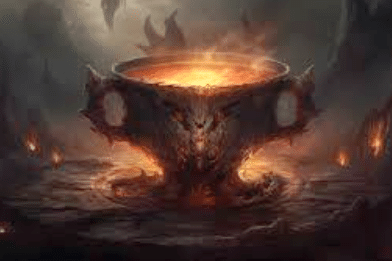
| [theme] : the ‘cup (-of fury)’ of God for mystery-Babylon : as a pay-back for their ‘cup of dregs’ as their gloomy cave in which they had imprisoned the crystal floor — [Jer.51 context :] Babylon falls when we found the stone [and Christ sends him back – for his attribute IS the stone] [also : Rev.17 the whore , Is.51] + ‘millstone’ examples [Dan.9 : no ‘half of the week’ but ‘two halves of heaven’] [Zech.5 : no ‘10 x 20 flying scroll’ but “floor & 7 torches”] [Gen.37-40 : ‘Joseph in the well’ — like the stone] [2025-01jan.25-26] |
| the idea of this ‘cup’ must come from somewhere and in Rgveda they also call their cave ‘the beaker’ : now we need to carefully disentangle the sections in the Scroll wherein this ‘cup’ shows |
|
theme
… ofcourse they do not call their own cave “cup of dregs” but they dó use the
word ‘dregs’ as the essence that remains behind when they ‘purify’ their Soma
[which is the creative-light by the imprisoned crystal-floor , see other pages] ;
while on the other hand God can only “give them the cup filled with His wrath”
and not ‘filled with dregs’ (because from where ?) : this difference is important ;
and this is a good lead ,
for in several chapters the word-cluster “millstone , cup and stone” appears
and there are enough examples for us to set this theme in a solid context ;
however — because Esau was not stupid only sections are restorable , sadly
use of the word ‘cup’ (as cave)
like with other expressions also this word can but be used in two ways :
either in “innocent every-day situations” ór linking to the intended connotation ,
wherefore lines like in Mt.20 are corrupt ,
(22)
“But Jesus answered and said, Ye know not what ye ask. Are ye able to drink of the
cup that I shall drink of, and to be baptized with the baptism that I am baptized with?
and they said unto him : we are.”
where both the type story and the ‘baptism’ are Esau’s inventions anyway ;
yet in following Mt.23 lines indeed the intended theme of ‘the cup’ again shows ,
(25)
“Woe unto you, scribes and Pharisees, hypocrites! for ye make clean the outside
of the cup and of the platter, but within they are full of extortion and excess.”
here ,
note how close to “the cup full of abomination in the hands of the whore” (Rev.) ,
where Esau cunningly turned the theme unto ‘himself’ — he couldn’t care less —
followed by the example of “they as grave with dirt inside” : the gloomy cave !
this – and the ‘millstone’ at Christ’s cave
… but from here we need to carefully observe other examples —
He cannot have said (Mt.26) “that this cup may pass from me” for the same
reason posed above and that is no offense because a phrase like “… this trial”
is a proper replacement ;
yet we immediately can make the connection between ‘the cave’ he rested in
and the “rolled-away matrix millstone” from the cave when he had risen ,
so that Christ himself must have the attribute ‘corner stone’ — the floor
and making sense when he carries óur attribute ‘the birth sceptre axis’ , no ?
also ,
the rolled-away stone may imply ‘that on his way , He sends back the floor’
[when he comes to earth he makes a stop sending the stone to tsiun first ,
as we posed in a recent page] becáuse it is His attribute
[sub :
not in this page but to be complete :
though in NT shows a line suggesting that ‘Christ is the corner stone’ as
context in the corrupted 1 Peter 2 that originally contained this theme :
(6)
“Wherefore also it is contained in the scripture ,
Behold, I lay in Tsiun a chief corner stone, elect, precious:”
this is true , as the returned floor in Revelation 21 (-page) ,
yet the next famous one makes no sense whatsoever – if ‘about Christ’ ,
(7)
“the stone which the builders disallowed, the same is made the head of the corner”
taken from the Isaiah chapter ,
here ‘builders’ may be ‘Adam (oik-odomeô=adam !)’ and the corresponding
action perhaps ‘sold out’ (apodokimazô=póleó) though we are not sure yet ;
but either way ‘as the summum of his revenge at base-10 and -7’]
three days more , your Majesty
yet nothing shows that it could happen
how horrible
and so defeated , virtually in hiding now ,
with this awful ape carrying the dead soul in her ,
dat after day after endless day
and all our others are beyond exhaustion
yet still trying to also present this theme properly
because it is the only thing we know and care for
it is true – I wouldn’t even gather myself , by now
but perhaps you will remember the many days
that we set all our life on understanding you
and you will end this hell for us .. in three days
#1 Isaiah 51
(22) but inversed ,
“Behold, I have taken out of thine hand the cup of trembling,
[even] the dregs of the cup of my fury; thou shalt no more drink it again:”
it has in (1) ‘dig out from cistern’ (‘cave’!) and ‘rock’,
in (3) ‘restore eden’ ,
in (4) ‘[something] goes forth .. to be a light (for) the people’ ,
in (13-14) ‘a foundation , the captive exile that is loosed’ ;
[yet without knowing it is the stone theme it is unrecognizable as theme here]
#2 Jeremiah 16
[too corrupted]
#3 Jeremiah 25 [worth a try ?]
in (5) ‘dwell in the promised land’ (the promise as part of the theme)
in (6) ‘anger’ (often connected to worshipping the 12-months)
in (9) ‘destroy & king of Babylon’ (Horus?)
in (10) ‘millstone & light’ (similar line as in Revelation)
[then in (11) starts that headache “70 years of Babylon” as the Daniel 9 one :
judging all , it must have been the “captured base-10 and -7” theme :
Dan.9 “half of – the week” as “the two halves – of heaven (shbth=shmim)” [sic !]
in spite of the alleged timeframe from Darius unto Christ ,
which may be a combination of ‘Luck’ , ‘Adam whispering’ and ‘a rather vague
decree that is difficult to prove’]
in (15) ‘cup of wine of fury’
in (19) ‘Pharaoh king of Egypt’ (a title for Horus)
in (30) ‘IEUE will roar from his habitation’ (Trumpet – returned stone & sceptre)
in (34) ‘[=your] pleasant vessel will fall’ (Torus?)
#4 Jeremiah 49
[but very corrupted]
in (10) ‘uncover the secret place’
in (12) ‘drink of the cup’
in (16) ‘dwelling in the encircling of the rock’ (floor at Orion)
[several key words show but : this either is about “the stone & sceptre & star”
because of the sections — ór a cemetery chapter (-of dumped cut-off lines)
#5 Jeremiah 51 [worth a try ?]
in (7-8) ‘the cup’ and ‘Babylon falls’ (line of the whore in Rev.)
in (11) ‘vengeance (for) his temple’ (juxta to the vengeance of Adam)
in (19-24) the complete restored construct stone & sceptre ?
in (25) something taken from a mountain (Orion?)
in (26) ‘take back the corner stone’
in (27) a ‘trumpet blown’ (same as the roaring in ch.25)
in (32) the gate ‘burned with fire’ (by the 7 Torches)
in (44) ‘punish Bel’ (reference to ‘base-12 zodiac’ ?)
(and the “(torus?) wall falls” , see line 58 “broad walls & lofty gates”)
[curious : closing 59-64 :
though corrupted it has “stone , scroll” and “a conclusion” :
a man when at Babylon has to read the scroll and proclaim the city’s fall ,
then tie the scroll to a stone and cast it in the river , symbolizing that —
what if “Babylon will fall when we understood about the stone” …? [sic]
#6 Lamentations 4
[we knew that books as this contained these type themes
but they are so mutilated that we cannot use them :]
in (20-21) ‘(something of-) IEUE taken in their pit‘ (‘cave’)
in (11) ‘foundation & anger’ ,
#7 Ezekiel 23
[second half from 30 onwards – but totally corrupted :
akin to the ‘Joshua valley’ (see page) the “Aholah & Aholibah” as ‘a pair’
must be ‘Leviathan (aele=luithn) and Behemoth (aeliBE=BEmth)” as an
utterly ‘romanticized version’ of this theme ;
the “image of the·sidewall=the heaven” should be ‘the 12-base zodiac’ theme
[and looks like earlier in Ezekiel “awful images on the wall”] ,
where now the ‘whoredom aspect’ is “Jacob following the 12-month year” ;
in (31-33) ‘drink of the cup’
in (38) ‘defiled my sanctuary’
in (39) ‘they came into my sanctuary’ (Locusts – to steal the floor)
in (41) ‘you set my incense and oil’ (stolen aspects the floor makes)
in (47) ‘stone’ and ‘burn with fire’ (the 7 torches burn that region) ,
#8 Habakkuk 2
[we never succeeded this one]
in (6) ‘laden with thick clay’ (sic – in the cave)
in (9) ‘nest on high’ (Orion?)
in (11) ‘stone cry and the (wooden-) beam of the wood answer’
[like the alleged ‘flying scroll’ lines in Zephaniah ? but as ‘descending stone’ ? ,
then no ‘10 x 20 flying scroll’ but ‘the 10-fold floor & 7 torches’ ; <<<
and line 4 ‘midst of the house’ was ‘(eden) in the midst of the (2) heavens’ ;
yet these lines are cut-off from a larger section ;
b)
interesting : Rgveda has “the vessel of wood” as the cave / purifying place ,
did it say here ‘wooden – vessel’ (Kphis=Kli)‘ also ? or why use it ?
in (12) ‘woe the city built by blood’
[also elsewhere — was ‘built upon the stone’ ? see attempt to Rev.17 below]
in (16) ‘the cup’
in (17) ‘violence of Lebanon covers you’ ,
[likely ‘the clay (chms=chmr) covered the stone (lBANn=ABN)‘
in (19-20) ‘arising stone’ and ‘temple of IEUE’
other :
Genesis 40
‘Joseph in prison’ :
it can be that at the start “Joseph thrown in the well” (Gen.37) alluded to the
stone theme — and much later also ‘Jeremiah was thrown into a well’ but who
knows that is a corrupted réal theme —
also because of his dream of “the sun and the moon bowing” (same 37) where
indeed the floor rules the eden-binary also , see Revelation 21 page ;
in context ,
there never was a ‘Joseph in prison with the baker and butler’ (ch.40) ,
not because we want to force that but it just makes no sense : the story sounds
nice but is completely useless and has no further context , wherefore it has to be
another invented toddler-story of Esau —
instead , it must have explained “the comparison with the stone in the well” ! [sic]
the word ‘butler’ can be ‘sceptre’ ,
in (11) it has ‘cup of Pharaoh’
and probably as “taking – the·grapes=the stone (oNBim=aNB)‘ ,
in (15) ‘stolen from the land’ (as a weird thing for Joseph to say)
[ofcourse it is almost impossible to restore these type mutilated sections
in which Esau re-used all the components (also ‘numbers’) in random order ;
b)
problem is what then we do with the óther stories :
perhaps Joseph was never in prison altogether but came to high rank as
in the (corrupted-) book ‘Joseph and Asenath’ (page) that originally further
explained this theme including the sceptre and the star (Asenath) ;
c)
wherefore the impossible “Joseph and his brethren” (ch.42-44) where they
come to buy grain and return but find money in their bags , that never made
sense to us , can have been Esau’s version of “the returned sceptre & stone”
per for example ,
the “put my cup, the silver cup, in the sack’s mouth of the youngest” (44:2)
as ‘in the cup, the clay cave, put the stone in the mouth of the cave’ (?)
where “great stone in the mouth of the cave” also showed in Joshua 10 ;
d)
it doesn’t mean that there was no emotional reunion with Jacob ,
in fact it should be because of the similarity with ‘the stone returning’ ,
but Esau must have greatly overdone this – and buried the stone theme …
Exodus 14
the ‘army drowning in the Red sea’
we know that the plagues did not happen in earthly-Egypt but in Egypt as
the land of mystery-Babylon and this must have been the original reason ,
not ‘the people crossing the sea’ but ‘the stone crossing to it’ (or ‘heavens’)
but to be honest we still need to have a hard look at this 14 ;
or in fact ‘at this whole event’ : because of the finds in recent months ,
there may have been “10 plagues” (eden’s base-10) , afterall ,
and considering the type plagues these may be true :
– the darkness , obviously ,
– the locusts : but probably as “the 4 locusts” (Horus sons) going crazy —
for in Rgveda these ‘Maruts’ are a kind of policemen that are very feared
and since they have a stolen-eden-body perhaps these were affected
and they started injuring their people ,
– the blood : but “as eden-redness” ,
in spells as T’ESHER ‘red substance , blood, gore’ which they need but
cannot bear in her original (eden-) form ; and because this redness also
creates their realm a sudden more pure (eden) form can have affected it ;
| – the hailstorm : in the spells ‘one of the seven torches’ directs it now as théir hailstorm , and in Rgveda it is said as a good protection against eden — circling around their Torus (or who knows ‘as’ its wall) , |

|
wherefore it is very possible it broke down and rained down upon thém ;
4 out of 10 is a bit poor score ,
but “flies, gnats and frogs” have nothing to do with the imprisoned stone
while none of those roots reveals a possible real theme – yet
Revelation 18
[the babylon-whore chapter , see below]
[double !-] millstone :
Exodus 11
at the plagues of Egypt –
maintaining that the alleged ‘crossing of the Red sea’ was the reason (above) ,
in this very corrupted chapter show a couple of useful lines that seem to tell
what will happen ‘in the latter days’ : that the stone will return ,
but Esau moved the section to conceal it under the ‘Egypt’s firstborn slain’ ,
(4)
“And Moses said,
Thus saith the LORD, About midnight will I go out into the midst of Egypt:”
but
[=in] the·night (=tampered & swapped) = the days of – the mid=end (chts-h=chts)
b
I (will) go forth – into the midst of – (matrix-) Egypt (‘where the floor is’) ,
here ,
it doesn’t have ‘pass through’ (-obr) but has a certain goal ,
while it’s not so important in this line whether He or Christ goes there ;
Esau saw the danger coming and murdered next line :
(5)
“And all the firstborn in the land of Egypt shall die, from the firstborn of Pharaoh
that sitteth upon his throne, even unto the firstborn of the maidservant that [is]
behind the mill [=millstones] ; and all the firstborn of beasts.”
why use ‘mill’ here ?
perhaps ‘(remove) the maid=stone that is behind=under (achr=thchth) the millstone’ ?
which causes ,
(6)
“And there shall be a great cry throughout all the land of Egypt,
such as there was none like it, nor shall be like it anymore.” <<<
this buildup makes Sense ,
for “the howling” shows in many chapters of all the examples listed above
[though we didn’t include these to not overcomplicate things]